
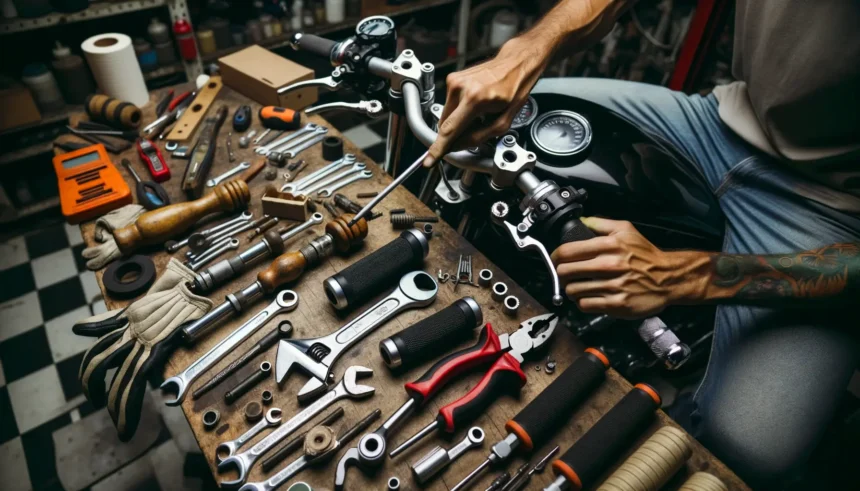

Investing in the appropriate tools will make auto body work simpler and more effective, as well as help keep your shop organized.
Shot blasting cabinets make it quicker and safer to grind, deburr, or sand automotive surfaces more quickly, but these tools must be used appropriately to ensure their effectiveness and safety.
Paint Spray Gun
Recommended: the DIY body-work toolkit
Handpicked Amazon products relevant to this guide. Prices vary, links go to current Amazon listings.
Paint spray guns are essential tools for most painting jobs. While there are various kinds of guns that you could use for bodywork painting projects, high-volume low-pressure (HVLP) guns are the most widely used option. Before beginning to paint, it is advised that you test out your sprayer on scrap material to adjust air, fluid, and fan knobs and ensure an even spray pattern.
Most paint sprayers feature separate passages for air and fluid, with the paint emerging through a nozzle at one end. When you press the trigger, air combines with fluid to atomize it and allow paint to be expelled through the nozzle in a fine mist form.
As you are ready to paint, ensure the nozzle is set up vertically or horizontally for side-to-side movement or up and down movement respectively. Keep your gun 6-12 inches from the product surface or an approximate hand’s distance away, moving at an even pace while keeping your wrist straight throughout each pass; and ensure you overlap each pass by about 40%.
Putty Knives
Putty knives are a useful tool that can serve multiple functions, from smoothing putty and applying spackling compounds, to scraping paint off surfaces, to removing it altogether. Available both with flexible and stiff blade varieties – stiff blade putty knives provide more durability for heavier scraping tasks while flexible ones offer some degree of flexibility and ergonomically designed ones may help to reduce worker fatigue and lower risks of injuries that require costly workers compensation payouts.
Most popular putty knives typically measure two, three and four inches wide and can be used to fill nail holes, patch divots, spread drywall mud into seams and joints as well as remove peeling paint. Some models can even be used to scrape away peeling paint; it is important that any tools that come into contact with old paint must first be tested with a lead testing kit for toxic materials such as lead. They should also be maintained regularly by adding machine oil coating for corrosion prevention purposes.
Suction Cup Dent Puller
Suction cup dent pullers are simple tools designed to quickly and affordably remove unsightly dents from your vehicle. Like a toilet plunger, its flat pulling tab attaches directly to dented body panels where upward pressure can be applied by either pulling up on it or screwing upward pressure mechanisms.
Car body repair tools come in different styles and are available for purchase. Some kits consist of simply attaching a flat pulling tab directly to a dent, while others involve gluing or fastening the tab onto a pole and sliding it along it while adding upward pressure with weighted pull tabs attached for greater results.
Prior to using a suction cup dent puller, the affected area should be thoroughly cleaned and rinsed, while remaining dry to enable the suction tab to adhere firmly to body panels. Once attached to a dent, locks on both handles can be tightened together in order to create sufficient vacuum pressure necessary for pulling away panel.
DIY dent removal methods such as using suction cups may reduce the appearance of damage on vehicles, but cannot fix it fully. Metal requires highs and lows to be addressed during repair processes – while suction cups only pull soft lows back up, thus rendering dings mere cosmetic corrections rather than actual repairs.
Stud Welder Dent Puller
Stud Welders are an effective and quick way to remove dents from the backside of your vehicle without drilling holes. They work by welding a small stud onto its metal, which can then be pulled on to push out dents from body panels with shallow dents. You can find one in many auto parts stores as well as pawn shops or Craigslist.
Once the gun is activated, stored energy is released to melt a full diameter of a fastener’s base and some of its parent metal to form a high-quality fusion weld. After welding is complete, its spring load forces its outer contact ring directly against the work surface, creating a permanent bond.
Once welds have been attached to each indentation along its crease line, use a heavy-duty slide hammer with an internal-outside motion to pull each dent out completely. After you’ve finished pulling them all out, use a body hammer to tap out and smooth any remaining flat spots.
Disc Sander
The Disc Sander is a powerful power tool designed for smoothing and finishing materials like woods, non ferrous metals and plastics. Additionally, it can also be used to remove small amounts of waste material.
This versatile machine is easy to operate and can accommodate different sanding discs of different grit levels for surface sanding applications. This helps boost productivity in any shop as greater control over surface sanding provides increased productivity.
The sanding process begins with using a low-grit disc to remove paint or body filler, followed by higher grit sandpaper to prepare the surface for primer application and finally high grit sanding to smooth any imperfections in the primer for an exceptional final paint job. Jigs that make curved surface sanding simpler may also come in handy for outside curves, ovals, and rounds; these tools can be found at many shops at affordable prices.
Dual Action Sander
Dual action sanders are versatile power tools designed for finishing work on buffing projects. Their high speed and powerful motor make them lightweight; furthermore, they produce less vibration compared to other sanders.
There are numerous types of dual action sanders, and their designs vary in terms of the shape of their sandpaper pads. Some have rectangular pads which spin in an alternating rotary motion like belt sanders while others feature circular pads similar to disk sanders.
No matter the shape of its sandpaper, a dual action sander is designed to remove less material than either belt or disk sanders – helping reduce chances of scratched surfaces that compromise finish quality.
A DA sander is an indispensable tool for auto body work, from shaping putty repair patches to smoothing metal surfaces prior to painting. Additionally, they’re useful for shaping wood. When selecting an electric DA sander it is essential to take note of its power source and pad size when making your selection.
Grinder
A grinder is a multifunctional power tool used to remove excess material, smooth welds, and shape body panels. Collision technicians rely on them for efficient multiple task completion at once, saving both time and effort by streamlining multiple tasks at the same time. Choose the appropriate grinder model based on your budget needs and budgetary considerations.
An air compressor is an indispensable piece of equipment for any auto body shop that provides paint services. Not only does it speed up and ease the painting process, it helps keep your workspace cleaner while providing consistent spray patterns that produce flawless finishes. When purchasing one of these tools it is vital that it provide consistent spray patterns for a smooth finish and consistent spray patterns for consistent spray patterns.
Slide hammers are essential tools for collision repair professionals. Their unique design enables technicians to re-align metal panels and fix dents without harming surrounding areas, thanks to its long round shaft equipped with a sliding hammer weight producing force without actually striking the panel directly. Plus, this tool comes equipped with attachments specifically tailored for different repairs!
HVLP Gun
HVLP Guns can be used for an assortment of projects from painting furniture to staining wood, from using them for thin coatings on furniture to accentuating natural grain patterns in wood grains with stain. Their high volume air usage is converted to low pressure by way of low-pressure compressors reducing overspray and waste paint by as much as 90%! HVLP guns also work perfectly when applied over thin coats highlighting natural grain features in wood grain patterns.
HVLP guns can be powered by either a turbine or compressor and come in three configurations; suction feed (where paint cup sits directly below gun), gravity feed and pressure fed (using separate pot connected by fluid hose). They offer superior coverage compared to airless sprayers but still produce fumes; to maximize effectiveness use in well ventilated spaces.
HVLP guns offer several advantages when it comes to painting with thinner paints, saving both money and effort in the long run. Plus, their low pressure allows them to operate safer in confined spaces and reduces risk of skin injuries caused by overspray – another significant expense saver! Plus they help limit overspray which causes mess and splatter.