
Updated April 2026. How to plan and execute a car paint job — at home or at a shop — that holds up for a decade instead of fading in a year. Real prep timelines, the equipment that matters, and what shops charge for each tier. As an Amazon Associate we earn from qualifying purchases.
A car paint job is 80% prep and 20% spraying. The prep is what determines whether your repaint looks factory in five years or starts to peel in eighteen months. Whether you’re hiring a shop or doing it yourself, understanding what good prep looks like is the difference between a $1,200 result and a $5,000 result.
The Paint Job Tiers
| Tier | Cost | What you get | Lifespan |
|---|---|---|---|
| Single-stage budget (Maaco-tier) | $700–$2,000 | Minimal prep, basic single-stage paint | 1–4 years |
| Mid-tier (base + clear) | $3,000–$7,000 | Body work, real prep, urethane base/clear | 5–10 years |
| High-end | $8,000–$15,000 | Block sand, multi-stage paint, color match | 15+ years |
| Show quality | $15,000–$30,000+ | Bare-shell prep, custom color, glass-flat finish | 20+ years with care |
What you actually pay for at each tier
- $700–$2,000 (single-stage): Scuff the existing paint, mask, shoot a single coat of pigmented paint. No body work. Visible imperfections from the previous paint show through. Acceptable for older cars where appearance doesn’t matter long-term.
- $3,000–$7,000 (base + clear): Light body work to fix obvious dings, sand to substrate where needed, real primer sequence, base coat + clearcoat. Looks good, lasts.
- $8,000–$15,000 (high-end): Full body sand-down, block sanding for a flat surface, body work on every imperfection, multi-stage paint with color matching to factory specs.
- $15,000–$30,000+ (show): Strip to bare metal, hours of block sanding between every primer coat, often custom colors or rare metallics, glass-flat final finish.
Single-Panel Repaints (Repair, Not Full Job)
Most people don’t need a full repaint — they need a single panel repainted after a dent or scratch repair. Pricing:
- Spot repair (small area within a panel): $300–$800
- Full single-panel respray: $500–$1,200
- Two adjacent panels with blend: $1,000–$2,000
Blending into adjacent panels is critical for metallic and pearl colors — without it, even a perfect color match looks “off” from certain angles.
The Prep Sequence (What “Good Prep” Looks Like)
Day 1: Assessment and dismantling
Remove trim, badges, lights, and anything that’s faster to remove than mask around. Wash thoroughly. Identify every dent, scratch, rust spot, and paint failure area. Photograph the existing paint code from the door jamb sticker.
Day 2: Sanding the existing paint
For a basic respray, scuff existing paint with 320–400 grit (around 1,000 grit total for the whole car). For body work areas, sand down to bare metal where needed.
Days 3–5: Body work
Hammer-and-dolly any dents, apply body filler, sand to 80 → 180 → 320. See our body filler comparison for picks.
Day 6: Primer
Epoxy primer over bare metal and filler, then high-build primer over the whole car. See our primer guide.
Day 7: Block sanding
Sand the high-build primer with 320 dry then 600 wet. This is where you produce a glass-flat surface. Skip this and orange peel shows through your final paint.
Day 8: Final masking
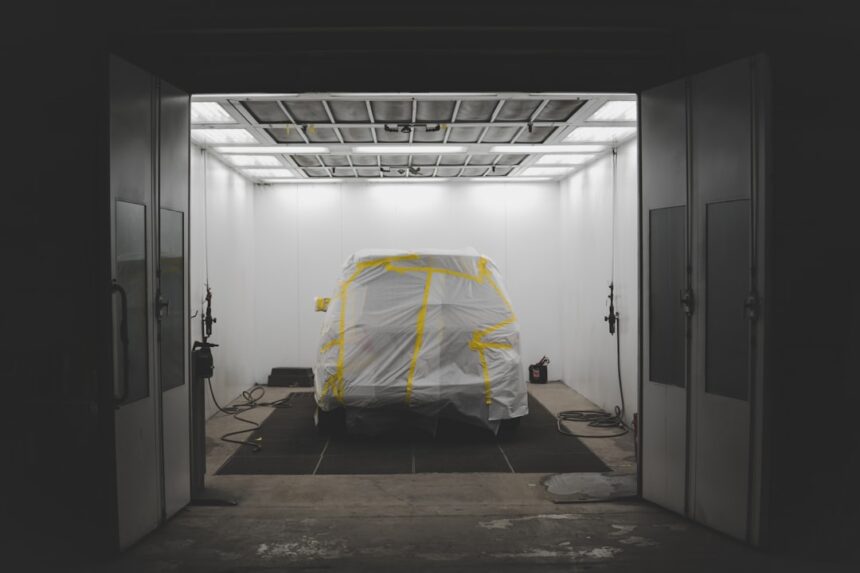
Cover everything that isn’t getting painted. Use plastic sheeting and quality automotive masking tape — not generic blue painter’s tape, which leaves adhesive residue.
Day 9: Paint
3 coats base, 5–10 minute flash between. 2–3 coats clear, 10–15 minute flash between. Booth temperature 70–80°F, low humidity.
Days 10–14: Cure, color sand, polish
Let clearcoat cure for at least 24 hours, ideally 7 days. Color sand (1500 → 2000 → 3000 grit, wet) to remove orange peel. Polish to mirror finish.
That’s a 2-week project for a single car at the mid-tier. Cheap shops compress this to 3–4 days and the corners cut show in the result.
DIY Paint Job: What’s Realistic
What you can DIY
- Single-panel respray (bumper, fender, hood): yes, with practice
- Full-car single-stage budget paint: yes, expect 60% of shop quality
- Spot repair: yes, with aerosol cans for small areas
What you generally can’t DIY
- Multi-stage metallic or pearl colors (need a colorist’s eye)
- Show-quality finish (requires booth, training, color sanding skill)
- Modern factory finishes on Audi, Mercedes, BMW (extremely complex multi-coat systems)
Equipment you’ll need
- HVLP spray gun ($80–$300). Browse HVLP guns on Amazon.
- Air compressor — at least 60 gallons, 5+ CFM at 40 PSI. The single biggest equipment expense.
- Respirator with paint cartridges (not paper mask). Automotive paint solvents are no joke.
- Booth space — clean, dust-controlled. A garage with plastic sheeting walls and a fan with filter works for non-show jobs.
- Paint, primer, hardeners, reducer. Plan on $300–$800 in materials for a full-car job.
- Sandpaper assortment, sanding blocks, masking tape, plastic sheeting.
Skill development
Practice on a junkyard panel before your daily driver. The first few attempts will run, fish-eye, or orange-peel. Watch real shop videos (not influencer content); the technique is harder than it looks.
Color Matching: Why Shops Charge More for Some Colors
Solids (white, black, basic red)
One pigment color. Matches predictably. Cheapest to repaint.
Metallics
Tiny aluminum flakes give the color depth and angle-shift. Application angle and gun distance affect appearance. Requires blending into adjacent panels.
Pearls
Mica flakes added to base coat. Color shifts dramatically with angle. Requires precision color matching.
Candies and tri-coats
Multiple-layer system: base + tinted clear + clearcoat. Requires a colorist and precise spray-pattern control. The most expensive to repair.
The repair implication
If your damaged panel is a tri-coat color, expect a 30–50% surcharge on the repair compared to a solid color. Some specialty colors require a colorist who computer-mixes from a sample, which adds time and material cost.
Common Paint Job Mistakes
- Painting in poor conditions. Below 60°F or above 90°F, humidity over 70%, dusty environment — all cause defects. Wait for the right day.
- Wrong reducer for the temperature. Slow reducer in cold weather = paint that won’t flash. Fast reducer in hot weather = orange peel.
- Skipping the tack cloth before spraying. Removes residual dust and lint from sanded surface. Without it, you get debris in your topcoat.
- Going too heavy on the first coat. Light first coat for adhesion; build with subsequent coats.
- Painting in direct sunlight or wind. Both cause uneven flash and runs.
- Not letting the clearcoat fully cure before color-sanding. 7 days minimum, ideally 14.
Paint Job Lifespan: What to Expect
Modern automotive paint (urethane base + clearcoat) is rated for:
- Manufacturer factory paint: 10–20 years with normal care
- High-end aftermarket job: 10–15 years
- Mid-tier aftermarket job: 5–10 years
- Budget single-stage: 2–5 years
Variables that shorten this: UV exposure (parking in sun all day), industrial fallout, bird droppings left to etch, automatic car washes with brushes, road salt, and ocean air. Variables that extend it: garage parking, regular washing, occasional wax or sealant application, prompt repair of chips.
FAQ
How long does a full car paint job take?
Mid-tier base + clear: 2 weeks of actual work, often spread over 3–4 weeks of calendar time. Budget single-stage: 3–5 days. Show-quality: 2–6 months.
How much does it cost to paint a car?
Budget shop: $700–$2,000. Mid-tier: $3,000–$7,000. High-end: $8,000–$15,000. Show: $15,000+. The variation comes from prep depth, paint quality, and finish work after color application.
Can I paint a car at home?
Yes for budget single-stage work. With $1,500 in equipment (compressor, gun, respirator, materials) and a clean garage, a careful DIYer can achieve a result close to a $1,500 shop job. Mid-tier and above require professional equipment and skill.
What’s the cheapest way to paint a car?
A Maaco-tier single-stage paint job ($700–$1,500) is cheaper than DIY equipment costs for one job. DIY makes sense only if you’ll paint multiple vehicles or do regular bodywork.
Why does my new paint job look different from the rest of the car?
Almost always due to: paint not blended into adjacent panels, wrong color formula, or inadequate clearcoat. A reputable shop will fix this under warranty.
How long should I wait to wash my car after a new paint job?
30 days before any car wash. 90 days before any wax, sealant, or polish. The clearcoat continues curing for weeks; introducing chemicals or pressure too early causes streaks or premature failure. See our washing-after-paint guide.
The Bottom Line
Paint quality is overwhelmingly determined by prep, not by paint brand or shop pricing alone. A mid-tier shop with thorough prep produces better results than a high-end shop that cuts prep time. Whether you’re hiring or doing it yourself, the question to ask is: “How many days of prep before paint?” If the answer is less than three, expect a result that matches.
For the underlying steps, see body filler comparison, primer guide, and rust repair guide.
Related Guides
Best Car Scratch Remover 2026: 7 Products Tested for Light, Medium & Dee… →Best Touch-Up Paint for Cars 2026: 5 Options for Rock Chips & Scratches →What Is Paintless Dent Repair? 2026 Cost, Eligibility & Process →Bumper Repair Cost 2026: Front, Rear, Plastic, and Painted Compared →How Long Does a Car Paint Job Take? Real Timelines by Scope (2026) →
Honda Body Repair Cost 2026: Real Prices for Civic, Accord, CR-V & Pilot →Toyota Body Repair Cost 2026: Camry, Corolla, RAV4, Tacoma & Highlander →Hail Damage Repair Cost & Insurance Guide 2026 (PDR vs Conventional) →Dent Repair Cost 2026: Complete Estimator by Damage Size & Location →Hail Damage Repair 2026: Cost, Process, DIY Options, and Insurance Guide →