
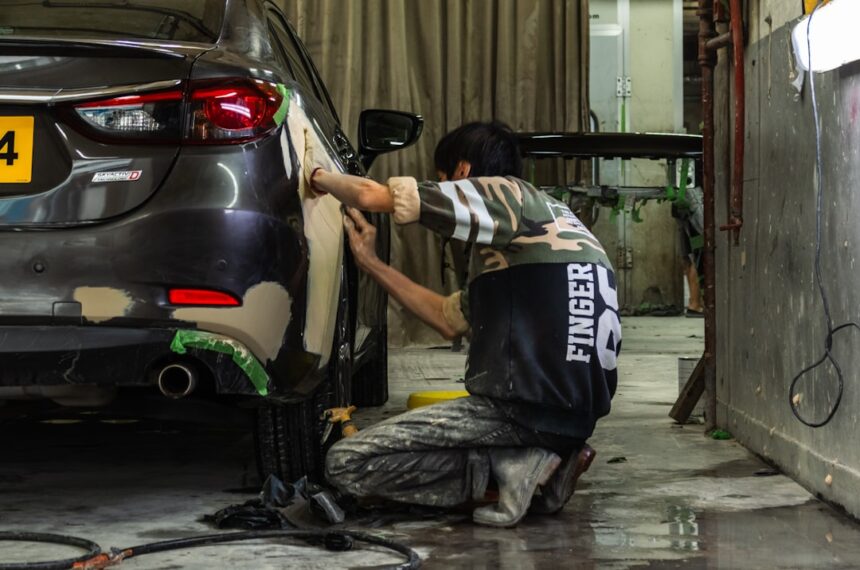
Auto body repairs often require extensive sanding to smooth away any side effects caused by fillers, welds or other repairs. Eastwood offers an assortment of sanding blocks to make this task simpler.
Use of a guide coat when sanding will enable you to detect any high spots that need attention and maintain the curvature of the panel in your work space. Here are three tips for using this method of sanding to achieve that silky smooth finish you desire.
Choosing the Right Grit
Recommended: fix small dents at home
Handpicked Amazon products relevant to this guide. Prices vary, links go to current Amazon listings.
Correct grit selection is crucial when undertaking any sanding project. An improper grit may damage surfaces and leave behind deep scratches that are difficult to eradicate; while using high quality grit will leave surfaces smooth enough for painting or refinishing.
Grit sizes range from very coarse to extremely fine; coarse grits are best used to remove heavy paint and rust buildup while finer grades remove fine scratches while simultaneously smoothing surfaces. Selecting an appropriate grit is key for successful Auto Body Sanding jobs.
Different grits work better for different metals. Low numbered sandpaper such as 180 or 120 grit should be used for removing rust and surface damage; medium-grit sandpaper (400-600 grit) may also be useful in smoothing vehicle surfaces prior to applying base coat; finally high grit (1000-2000 grit) may be applied as final polishing steps.
Before beginning sanding, it’s advisable to wash and inspect your vehicle to identify any hidden damage or flaws. This will allow for an efficient sanding process and help ensure a quality finish is reached.
As part of your sandpaper use routine, always utilize a block. This will prevent your sandpaper from becoming clogged up while simultaneously covering more surface area. Furthermore, having a block will help maintain an even pattern and ensure no areas go neglected during sanding.
Avoid Over-Sanding
Over-sanding is a common sanding error, where too much material is removed from the surface, leading to loss of adhesion and defects in the paint job. To avoid this mistake, technicians should regularly run their fingertips over panels in order to feel for rough textures that might not be visible visually.
Body panels with undulating surfaces can be challenging to sand flat with even professional hand-held auto body sanders, so technicians should employ foam sanding pad rolls as a solution to meet this challenge. Foam pads conform perfectly to contoured panels while still remaining smooth and consistent – this provides an efficient alternative to blocks which are difficult to hold around curves.
Uneven sanding is another common sanding mistake, leading to surfaces that aren’t smooth or uniform. This may be caused by improper technique, variations in pressure or using old, worn-out sandpaper – so it is vitally important that quality sandpaper be regularly checked for cuts or holes and replaced when necessary.
Repaired body damage or ready to apply a fresh coat of primer? Sanding is key to creating a seamless and long-term finish on any vehicle, and proper sanding techniques will ensure maximum effectiveness from Auto Body Sanding. Here are some helpful hints for avoiding common mistakes when auto body sanding: Avoiding common sanding mistakes will not only ensure a professional paint job, but will also safeguard both your health and safety. Sanding operations produce airborne dusts containing hazardous substances such as chromium and lead from surface coatings as well as abrasive particles from sandpaper, as well as potentially irritating particles produced during their processing. These dusts can irritate workers’ lungs and nervous systems, leading to bronchial asthma attacks, perforations of nasal septum perforations, skin irritation, as well as exceeding OSHA’s REL (recommended occupational exposure limit). To minimize exposure risks and exceed RELs safely, technicians should use ventilated mechanical sanders whenever possible and wear a respirator when handling any type of abrasive product like Body Filler.
Avoid Under-Sanding
As it can be easy to overlook areas that require further work, it’s wise to touch the panel regularly with your hand when block sanding – you may find your fingertips detect what your eyes don’t, helping ensure no high or low spots remain missed in your sanding process.
As well as choosing an appropriate grit, it’s also essential that sanding proceeds in an even fashion across the body panel, alternating sides. Doing this will prevent creating low spots in one area while simultaneously leaving high spots. In doing this way, body filler coverage remains uniform across the panel.
Before applying body filler, it is also a good idea to sand the bare metal down to a smooth surface using a sanding cloth with appropriate thickness – this will ensure that it matches both color and texture of existing paint on the car and will prevent further corrosion or rust issues in the future. If in doubt about which thickness to use for this task consult the paint code on your vehicle compliance plate or contact manufacturer.
As part of your auto body sanding efforts, it’s advisable to wear protective gear such as a dust mask, safety glasses, gloves and hearing protection. Sanding dust can be dangerous when inhaled; long-term exposure may result in bronchial asthma attacks, perforations of nasal septum perforations and lung damage, while shorter term exposure could cause dermatitis, nosebleeds and kidney failure. A ventilated space with plastic sheeting covering connecting doors is ideal to keep fumes out
Avoid Excessive Pressure
Auto body repairs may become necessary following accidents, weather events, runaway shopping carts or even baseballs striking cars. Auto body technicians must adhere to proper sanding procedures in order to guarantee that clients’ cars look like brand new when leaving their shops. Pro Tip: Use an orbital or straight line sander equipped with an HVLV local exhaust ventilation system in order to control airborne dust concentration during body work.
Excessive pressure while sanding will create “natural” grooves on the vehicle surface, leading to an amateurish and subpar finish paint job. When hand sanding, make sure that your palm always faces down when holding the sandpaper; apply an even amount of pressure across all areas; if using a flexible block, consider getting one which conforms better to its curvature for less flat spots and better coverage.
Avoid over sanding as this will create uneven surface areas and expose metal underneath your final coat of paint, which will show itself upon repainting and may result in unsightly pinholes that are difficult to fix later on.
Sanding can be exhausting work, so it is crucial that you take breaks every few minutes to give your fingers and wrists time to recover. In addition, investing in some sanding gloves could protect your hands while providing additional gripping power when using the block sander, helping reduce fatigued hands from making errors by helping grip tightly on it more firmly than previously possible. These will also prevent mistakes from being made as often.
Avoid Excessive Dust
Sanding is an integral component of auto body repair, helping ensure damaged parts and paint appear like new again. While each shop uses its own technique when it comes to sanding, many technicians share common best practices when it comes to this step of repair.
One of the most essential steps you can take is ensuring that your staff uses tools with adequate ventilation, to reduce dust levels and ensure safe air in your shop. Furthermore, employees should wear masks and use dust extraction systems in order to protect themselves against fine abrasive particles produced by these tools.
Make sure your tools are in good shape, suitable for the task at hand and up-to-date. For instance, using an aluminum oxide sanding disc designed for automotive work will decrease abrasive particle production – helping keep the air cleaner while making it simpler for your staff members to wear masks.
As when working with a DA sander, it’s crucial not to rush the sanding process. Take your time and work carefully, making sure all areas have been evenly sanded and any imperfections removed before moving on to the next grit level for a flawless and smooth finish.
Auto body sanding is an integral component of auto restoration, yet can create potentially hazardous working environments. Sanding dust contains chemicals and heavy metals such as chromium, lead and diisocyanates which can be toxic to our lungs and nervous systems when inhaled over a long period. When these substances are breathed in for too long they can even cause medical conditions like bronchial asthma, dermatitis and ulceration if inhaled in large enough quantities over time.