
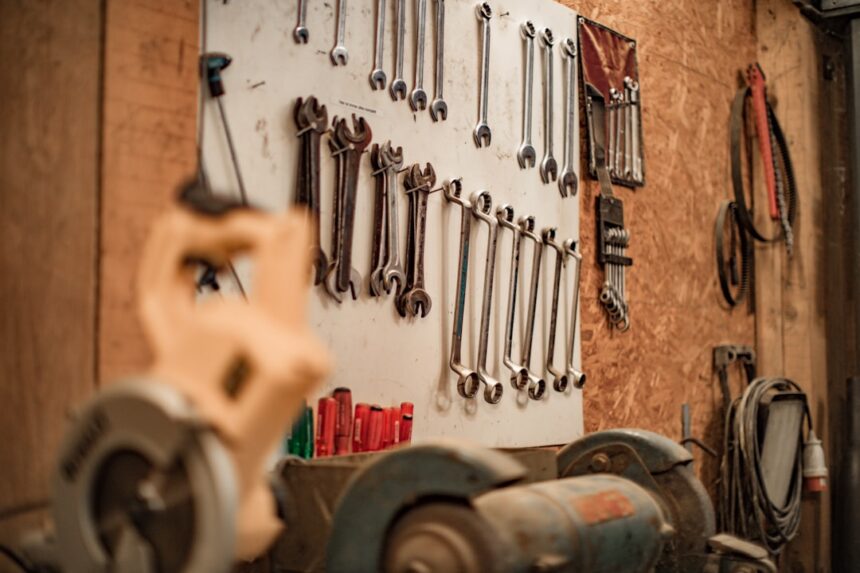
No automotive repair shop would be complete without the right tools, including auto body tools for repairing and refinishing damaged vehicle panels. Auto body tools help technicians restore cars they work on to look as though they just rolled off of an assembly line!
Body shops rely heavily on several essential tools, including: hammers and dolly sets to shape metal; block sanders to refine surfaces using different grits of sandpaper; air compressors and paint spray guns are also essential tools.
Paint Spray Gun
Doing your own painting or refinishing takes the right tools, and using a paint spray gun is one of the fastest and easiest ways to get the job done quickly. A paint spray gun uses compressed air to finely atomize liquid coating materials like paint, varnish and sealers with minimal effort required by you or anyone else. Typically designed with separate passages for air and fluid flows to allow users to select from interchangeable nozzles of different sizes depending on their task at hand – often featuring interchangeable air passages with interchangeable air passageways allowing users to choose air/liquid combinations depending on which paint thinner works best with oil-based finishes while latex paint thinner works best when applied for water-based finishes.
Suction cup dent pullers are an effective and non-invasive solution for fixing shallow dents, providing an effective non-invasive means of repair. Meanwhile, slide hammers offer more powerful repairs for larger dents which may help return metal to its original shape.
Disc sanders are an extremely versatile power tool, capable of performing multiple functions ranging from smoothing rough surfaces and prepping an area for sanding, to acting as heavy-duty grinders in any auto body shop. Their best models can help reduce swirl marks for consistent finishes while offering various attachments to accommodate curves or flat surfaces for sanding, plus can remove rust and old paint from surfaces.
Putty Knives
Putty knives (commonly referred to as joint knives) are among the most important hand tools a painter or repair professional needs in their tool belt. Used to scoop and spread drywall mud across seams and joints, putty knives come in various sizes designed for different tasks; some feature stiff blades for scraping while others have flexible designs ideal for spreading. Both plastic and metal models are available.
Eastwood provides both standard and specialty auto body hammers to any repair shop, which are an integral component of their repair services. Slide hammers are perfect for pushing out dents and bending metal back into shape without surface damage, while hard wood slappers help achieve similar effects without harming the finish surface. Finally, dolly sets and fender rollers offer finishing touches by straightening doors or fenders on low riding cars.
Disc sanders are essential tools in the automotive industry, providing basic sanding and shaping of body fillers as well as removal of spot welds. To extend their useful life even more, be sure to regularly clean and lubricate these tools to reduce friction-related wear while keeping everything running smoothly.
Suction Cup Dent Pullers
Bondo(r) Double Handle Locking Suction Cup Dent Pullers offer a fast and straightforward method to quickly remove large dents from car body panels. This tool offers an affordable alternative to expensive body work where holes must be drilled, filled and then the repair area sanded and painted over. Easy to use, they feature 300 times greater suction power compared to non-locking suction cup dent pullers.
Car owners know dents can be frustrating. There are various treatments offered by various companies, promising quick and inexpensive fixes for unsightly dents and dings. One method involves the use of suction cups which adhere to dented metal and pull it back out again; although this approach has its benefits; its success ultimately depends on several factors including size and depth of dent as well as whether or not the dent can be easily reached for removal.
Though you could theoretically use canned air to remove car dents from your vehicle, this approach is rarely effective. Canned air often results in stretching of metal which requires professional repairs as well as raised spots that need tapping with a mallet; furthermore, using canned air may actually aggravate existing dents further; therefore it should be left to professionals for best results.
Slide Hammers
Slide hammer attachments can be used to apply significant force and dislodge stuck or rusted components from their positions. Available in various sizes and weights, they are tailored specifically for specific tasks, such as unhooking inner tie rod ends/ball joints from their positions, separating U-joints or pulling gears etc.
A key to selecting an appropriate slide hammer attachment is making sure it suits both the size and weight of the component you will be working on, as well as taking into account what type of work will be performed – some attachments may be better suited to certain tasks than others.
Once you’ve selected an appropriate slide hammer attachment, simply place it over the end of the slide hammer and connect it to what needs to be removed. With steady hands and controlled force applied with whipping motions, use your slide hammer attachment to apply force as desired until item has been extracted from its location. Repeat this process as necessary until complete removal has taken place.
Use of a slide hammer attachment can significantly lower the risk of injury or damage compared to alternative methods, making it an invaluable asset for body technicians and auto mechanics. However, to extend its lifespan and ensure consistent, effective performance it is vitally important that users abide by manufacturer instructions, clean and lubricate periodically, store safely between uses, as well as follow any recommended maintenance schedules set forth by them.
Block Sander
If your job involves smoothing out auto body fillers, welds, or other defects associated with repairs, you’re going to require more power than can be provided solely by your hands alone. A block sander provides added leverage so you can ensure panels are perfectly smoothed out.
We carry flexible and rigid sanding blocks for every situation. A flexible block can bend easily to conform with curves on your project while rigid ones remain solid and ridged – each offering as much or little flexibility to provide you with an impeccable finish.
No matter if you’re using your hand or DA sander to block the surface, be sure to sand in an “X” pattern across the area so as to avoid leaving flat spots in the paint and ensure an even surface with no rough areas too rough for primer adhesion.
Some hand sanding blocks come equipped with clips or teeth to hold your sandpaper securely in place; these are designed to fit sandpaper sheets that would normally be used on power belt sanders, while others are larger enough to hold one quarter or half sheet of regular paper. Furthermore, some can even be converted to use pressure-sensitive adhesive sandpaper sheets using an attachment with vinyl face that can be cut down to size to suit a particular block – perfect for flat corners and other hard-to-reach places!
Body Hammer and Dolly
Though modern auto body shops are packed with cutting-edge metalwork equipment, hammers and dollies remain essential components of every shop’s toolkit. When used properly and with deft hands, these tools can perform miracles when it comes to restoring bodywork back to its original condition. Body hammers come in various types and sizes to meet the demands of any job. Dinging hammers feature flat and pointed ends designed for creating dents; picking hammers come equipped with flat ends with small domes to ease waves; shallow-domed hammers can be used on curved metal surfaces such as doors or fenders; fiberglass handles are often featured for durability while wood-handles reduce vibration, providing greater hand comfort. Dual-headed hammers offer both round and square faces to increase versatility when using one tool.
Dollies help hold metal pieces in place while you pound it out, and their curvature should closely correspond with the panel being worked on. Too much crown can create high spots; too little curve may only touch edges; low, medium and high crown dollies work best with most body panels.
To obtain optimal results with your hammer and dolly, it is crucial to learn proper usage techniques. Start off lightly, gradually increasing the force until your desired shape is reached. Make sure that both components stay in contact for optimal effects of each blow while minimising distortions.
Recommended Auto Body Tools
- Auto Body Hammer & Dolly Set (7-piece) — the foundation tool set for panel work ($40-80).
- 5-inch DA Random Orbital Sander — essential for smooth panel prep ($60-120).
- Paintless Dent Repair Kit — glue-pulling starter for small dents ($40-90).
- HVLP Automotive Spray Gun — for primer and paint work ($60-180).
- 110V MIG Welder — for patch panels and rust repair ($200-500).
- Nitrile Mechanic Gloves (100pk) — chemical-resistant, essential for prep and paint ($20-30).
Amazon affiliate links. The site earns a small commission on qualifying purchases.