
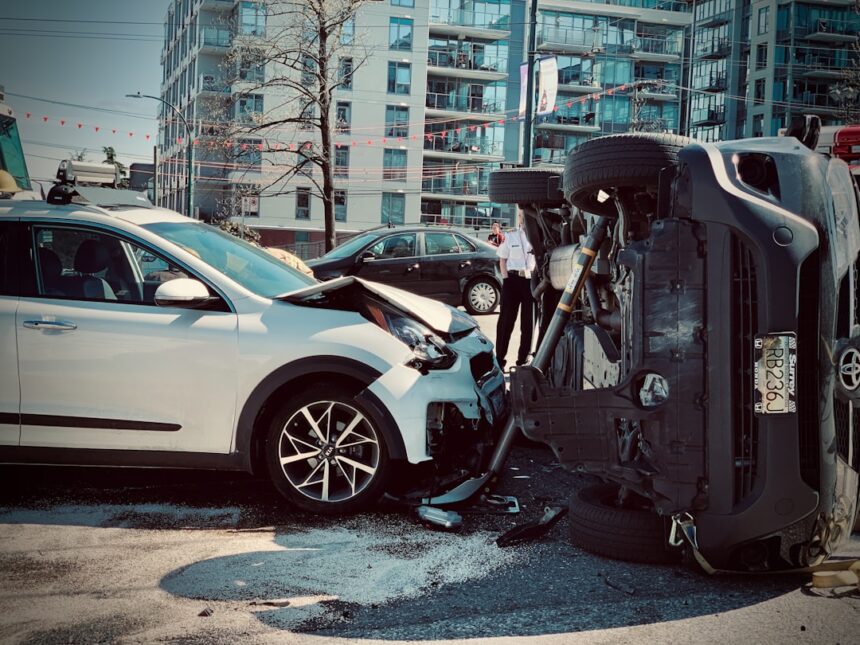
T-bone collisions (side impacts) are the second-most-common collision type and are dramatically more dangerous than rear-end or front-end collisions. Vehicle sides have far less crumple zone than the front or rear, meaning impact forces transfer more directly to occupants. Even moderate T-bone collisions frequently result in vehicle total loss and serious injury. This guide covers what to do immediately after a T-bone, the specific damage patterns to expect, injury claim strategy, and how to think through total-loss determinations.
Why T-bone collisions are different
The physics that matter
Side impacts are more damaging per mph than front or rear impacts because vehicle sides have minimal crumple zone. A 25-mph rear-end collision might result in a $6,000 repair. A 25-mph T-bone collision often results in a total loss and serious occupant injury.
Modern vehicles include side airbags, curtain airbags, and reinforced B-pillar structures specifically to mitigate T-bone impact forces. When these systems deploy, the vehicle almost always becomes a total loss because:
- Airbag replacement + control module reset: $2,500-$5,500
- Side impact structural damage: $6,000-$18,000+
- Multiple sensor calibrations: $850-$2,500
- Interior damage from airbag deployment: $1,500-$4,500
Combined total often exceeds 70-80% of pre-loss vehicle value, triggering total-loss determination.
Fault determination in T-bone collisions
Fault typically falls on the driver who violated right-of-way — this is usually the driver who ran a red light, ran a stop sign, or made an improper turn. However, comparative negligence often applies:
- Yellow-light-runners may share fault with red-light-runners
- Speeding through green lights may reduce recovery
- Distracted driving (verified by phone records) affects fault percentages
- Right-of-way violations vary by state — consult a personal injury attorney for anything beyond straightforward cases
T-bone damage patterns by impact location
Front door impact (most common)
When another vehicle strikes your front door area, expect this damage:
- Front door replacement: $2,500-$5,500 (often requires airbag replacement in door)
- B-pillar damage: $3,500-$8,500 (structural — requires expert welding)
- Rocker panel damage: $2,850-$6,500 (structural)
- Side curtain airbag deployment: $1,500-$3,500 replacement
- Front fender: $1,150-$2,250
- Wheel/tire damage: $450-$1,850
- Suspension/steering damage: $850-$3,500 (very common)
Rear door impact
- Rear door replacement: $2,150-$4,500
- C-pillar damage: $2,850-$6,500 (structural)
- Rear quarter panel damage: $2,500-$5,500
- Side curtain airbag (rear): $1,500-$3,500
- Rear wheel/tire damage: $450-$1,850
- Rear suspension damage: $850-$2,500
Direct B-pillar impact (worst case)
When impact is centered on the B-pillar between the front and rear doors, this is often the worst possible T-bone scenario:
- B-pillar is the primary structural component protecting occupants
- Damage almost always results in total loss
- Both front and rear doors often unable to open
- Serious occupant injury common — impact area is directly next to seated occupants
Front corner impact (offset)
Impacts to the front corner where the fender meets the front door:
- Fender + front door + A-pillar damage
- Front wheel/suspension damage
- Engine bay damage possible
- Airbag deployment likely (side curtain + front)
- Repair range: $8,500-$25,000, often totals
First 24 hours after a T-bone collision
At the scene
- Occupant injury assessment first. T-bones cause more serious injuries than other collision types. Call an ambulance for any complaint of pain, headache, dizziness, difficulty breathing, or numbness. Do not attempt to move injured occupants unless there’s fire risk.
- Document extensively. Take 30-50 photos: overall scene, both vehicles from every angle, road conditions, traffic controls (especially the traffic signal — including its state if you can safely capture it), skid marks, and debris pattern.
- Locate witnesses. Right-of-way disputes are common in T-bone collisions. Independent witnesses often make the difference between recovering damages or being blamed. Get names and phone numbers immediately.
- Call the police. A police report is essential for T-bone collisions because fault determination usually depends on who violated traffic law. Do not rely on informal information exchange.
- Preserve traffic-camera evidence. Many intersections have traffic cameras. Note the intersection name/cross streets in your notes so an attorney can subpoena footage if needed. Footage is typically overwritten within 30 days.
Same-day tasks
- Get comprehensive medical evaluation. T-bone injuries often affect the neck, back, ribs, and internal organs. Get a full ER evaluation same-day, including CT/MRI if any pain or symptoms.
- Preserve the vehicle in as-is condition. Do not authorize repairs, and do not clean out personal items until the vehicle has been inspected by your insurance adjuster (and potentially a personal injury attorney’s expert).
- File claim immediately. Both with your carrier and the at-fault carrier if you weren’t at fault.
- Consult a personal injury attorney. For any T-bone collision with injuries, this is essential. Attorneys work on contingency for injury cases — no cost unless you recover.
- Preserve all documentation. Every receipt, every medical record, every conversation with insurers should be documented with dates and content.
Total loss vs. repair — how the determination works
The total-loss formula
Insurers total a vehicle when repair cost + rental car + diminished value + potential future issues equals or exceeds a percentage of Actual Cash Value (ACV). Most insurers use 70-80% as the threshold; state law sets some minimums.
Why T-bone collisions often total
- Side impact structural damage is expensive to repair correctly
- Airbag deployment cost alone is $2,500-$5,500
- Multiple sensors require calibration ($850-$2,500)
- Alignment, wheel, and suspension repair often needed
- Interior damage from airbag deployment
- Even properly-repaired vehicles carry significant diminished value
Fighting a lowball total-loss valuation
If your vehicle is totaled, the insurer offers ACV based on their proprietary valuation (usually CCC ONE or Mitchell). These valuations typically run 8-15% below Kelley Blue Book Private Party value.
To maximize your total-loss recovery:
- Get Kelley Blue Book Private Party value for your specific vehicle (mileage, condition, options).
- Get NADA Retail value as a second reference.
- Compile comparable listings. Search AutoTrader, Cars.com, and CarGurus for identical vehicles for sale in your area. Save listings and prices.
- Document recent maintenance. New tires, recent brakes, recent transmission service all add value.
- Get independent appraisal if needed. For total losses above $20K, an independent appraiser ($150-$400) often recovers $2,000-$5,000+ additional.
- Request the insurer’s comparable listings. If they use CCC ONE, they should provide the comparable vehicles they used. Often these are lower-condition vehicles not truly comparable to yours.
- Negotiate. First offers are almost always negotiable. Come back with your documentation and specific value counter.
- Consider keeping the vehicle. If damage is repairable but insurer determined total loss, you can keep the vehicle for its salvage value (subtracted from settlement). Some owners rebuild the vehicle themselves.
Injury claim strategy for T-bone collisions
Common T-bone injuries
- Whiplash and neck strain
- Concussion (from impact to head)
- Broken ribs and clavicle
- Shoulder injuries
- Internal organ injuries (spleen, liver, kidney)
- Spinal injuries
- Traumatic brain injury (in severe cases)
Documentation you need
- Complete medical records from initial ER visit forward
- Ongoing treatment records (PT, chiropractic, specialist visits)
- Prescription records
- Employment records showing lost wages
- Photos of visible injuries
- Journal of pain levels and functional limitations
- All correspondence with insurers
What personal injury claims recover
- Past medical expenses
- Future medical expenses (projected)
- Lost wages during recovery
- Loss of future earning capacity if permanent
- Pain and suffering (varies by state, often 1.5x-5x medical expenses)
- Loss of consortium (marital relationship impact)
- Punitive damages (rare, only for gross negligence like DUI)
Why attorney representation matters
Studies consistently show represented claimants recover 3-4x more than self-represented ones, even after attorney fees. Insurance companies specifically target self-represented claimants for lowball offers. Almost all personal injury attorneys work on contingency — they only get paid if you recover, typically 30-40% of settlement.
Best DIY products for this scenario
BlueDriver Bluetooth OBD2 Scanner
Reads all vehicle modules including airbag control (SRS). Essential for post-collision diagnosis to identify all deployed and non-deployed sensor codes.
Check Price on Amazon →STDPRO 100-Piece Roadside Emergency Kit
Reflective triangles, first aid, jumper cables, tools. Should be in every vehicle before you need it.
Check Price on Amazon →Dupli-Color Perfect Match Paint
For post-repair touch-ups. Match your paint code exactly. Essential for maintaining vehicle value after repair.
Check Price on Amazon →Nextbase 622GW Dashcam
4K dashcam with GPS. Evidence in T-bone collisions where fault is disputed is invaluable. Prevention beats cure.
Check Price on Amazon →Chemical Guys Total Interior Cleaner
For cleaning airbag propellant residue and glass fragments from interior after collision. Safe on all surfaces.
Check Price on Amazon →Samsill Car Document Organizer
For keeping all your insurance, registration, and post-collision documentation together. Essential during claim process.
Check Price on Amazon →3M Scotchgard Paint Protection Film
For protecting vehicles after repair. Prevents future rock damage on repaired panels.
Check Price on Amazon →Nolo Personal Injury Guide
Understanding your rights and options. Complements attorney representation with self-education.
Check Price on Amazon →FAQ
Who’s at fault in a T-bone collision?
The driver who violated right-of-way — usually the driver who ran a red light, ran a stop sign, or made an improper turn. Sometimes both drivers share fault. Consult an attorney for anything beyond a clear-cut case.
Does auto insurance cover T-bone collision injuries?
Your medical payments (Med Pay) coverage covers your injuries up to policy limits. The at-fault driver’s bodily injury liability covers your injuries beyond your Med Pay. Your uninsured motorist coverage kicks in if the at-fault driver has no insurance.
Should I get a lawyer for a T-bone collision?
Yes if there are any injuries. Personal injury attorneys work on contingency (no cost unless you recover) and typically recover 3-4x more than self-represented claimants. For property damage only, self-representation is usually fine.
Will my T-bone collision total my car?
Often yes if airbags deployed or side impact damage is significant. Total-loss determination happens when repair cost + rental + diminished value exceeds 70-80% of vehicle Actual Cash Value.
How do I get a fair total-loss valuation?
Don’t accept the first offer. Get Kelley Blue Book Private Party value, NADA Retail value, and comparable listings. Negotiate with documentation. Consider independent appraisal for total losses above $20K.
Can I keep my car if it’s totaled?
Yes. You can keep it for its salvage value (subtracted from your settlement). Some owners rebuild the vehicle themselves if damage is repairable but insurer deemed it a total loss.
How long does a T-bone collision claim take?
Property damage: 30-90 days typically. Injury settlement: 6-18 months, often longer for significant injuries where full recovery time is unknown.
What if I get whiplash after the accident but felt fine at the scene?
Common — whiplash symptoms often appear 24-72 hours post-collision. Get medical evaluation immediately when symptoms appear. Document the accident and delay in symptom presentation. Insurance covers delayed-onset injuries in most cases.
Should I accept the insurance company’s quick settlement offer?
No. Quick offers within days of a T-bone collision are almost always below fair value. Wait until full damage extent is known and any injuries have been fully evaluated. Consult an attorney before accepting any settlement.
What paperwork do I need to file a T-bone injury claim?
Police report, medical records, employment records for lost wages, photos, witness statements, insurance information for all parties, and any correspondence with insurers. Keep detailed records of everything.
Bottom line
Get comparison quotes via our free quote form, or browse verified body shops in our national directory.