
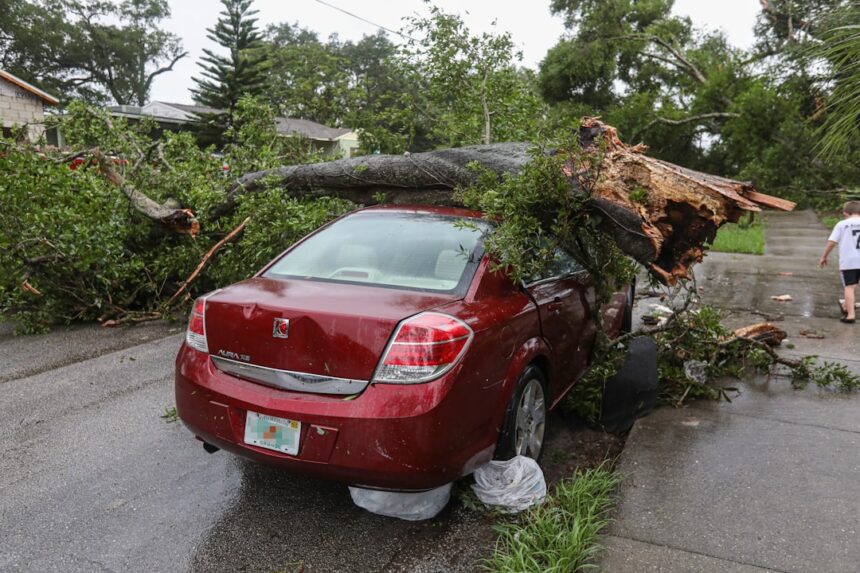
Trees are one of the most common non-collision damage sources for parked vehicles. From falling branches and full-tree impacts to sap staining and animal-attracted damage, trees create a variety of expensive problems. This guide covers what to do when a tree damages your car, the specific damage patterns and repair costs, the insurance angle (comprehensive coverage handles most tree damage), and how to prevent recurrence.
Types of tree damage to expect
Falling branch damage (moderate)
A medium-sized branch (2-4 inch diameter) falling onto a parked vehicle typically causes:
- Roof dents (usually 3-6 concentrated dents in the impact area)
- Windshield cracks or breaks
- Side glass damage possible
- Paint damage from branch scraping
- Antenna damage
Repair range: $2,500-$6,500 depending on extent.
Large branch or full tree impact (severe)
A large branch (6+ inch diameter) or full tree falling on a vehicle typically causes:
- Roof severely dented or crushed
- Windshield broken
- Body panel dents on hood, roof, and rear
- Frame damage possible
- Interior damage from crushed roof
- ADAS calibration required
Repair range: $8,500-$25,000+, often results in total loss.
Sap and organic damage
- Tree sap damages clear coat if left untreated
- Bird droppings under trees etch clear coat
- Pollen accumulation dulls paint finish
- Animal-attracted damage (squirrels chewing wires, birds pecking)
Repair range: $150-$800 for sap removal + paint correction.
Storm-related tree damage
- Wind-driven branches breaking windows
- Wind-toppled full trees on parked vehicles
- Ice-loaded branches breaking under weight
- Post-storm hazard branches falling days after the storm
Immediate steps after tree damage
Safety first (before touching the vehicle)
- Check for downed power lines. Trees often bring power lines with them. Never approach a downed tree without confirming no live wires are present. Call the utility company if in doubt.
- Assess tree stability. Is the tree fully down, or partially held up by the vehicle? A partially-held tree can shift and cause more damage or injury.
- Do not enter the vehicle if there’s any chance of additional falling debris.
Documentation phase
- Take photos from all angles before the tree is removed. Show the tree position, the damage, and any surrounding conditions.
- Photograph the tree source. If the tree came from someone else’s property (neighbor’s yard, park, road) — this matters for liability determination.
- Note weather conditions. Was there a storm? What time did it happen? These facts affect insurance claim processing.
- Preserve evidence. Don’t clean up debris until the insurance adjuster has documented everything.
Tree removal considerations
- Contact your insurance first before hiring a tree removal service. Some policies cover removal cost; others don’t.
- Whose responsibility is removal? If the tree was on your property, you pay. If from a neighbor’s property or public land, the property owner may be responsible. Consult your policy and local laws.
- Get 2-3 tree removal quotes. Emergency tree removal is expensive ($500-$3,000 typically). Non-emergency removal is cheaper.
- Consider partial removal. A tree service can cut the tree off the vehicle without removing the entire tree — often 40-60% cheaper than full removal.
Insurance coverage for tree damage
Which coverage applies?
Tree damage to your vehicle is covered under comprehensive coverage in nearly all cases. This includes:
- Falling branch damage
- Full-tree impact from storms
- Wind-blown debris damage
- Ice-loaded branch damage
- Storm-related paint or glass damage
Comprehensive is the coverage you need for tree damage. If you only have collision (not comprehensive), tree damage is not covered.
What about someone else’s tree?
Common misconception: many people believe if a neighbor’s tree falls on their car, the neighbor is liable. In most cases this is not true. Tree damage is typically considered an “Act of God” unless the tree was already visibly diseased/dead and the neighbor was warned. Even then, liability is complex.
Your comprehensive coverage handles the damage regardless of whose tree caused it. Trying to pursue the neighbor’s homeowner’s insurance often results in denial + damaged relationship.
Deductible considerations
Comprehensive deductibles are typically $250-$1,000. For minor tree damage under $1,000, filing may not make sense. For moderate damage $1,500-$5,000, filing is usually worthwhile. For major damage above $5,000, always file.
Total loss considerations
Vehicles with roof or A-pillar damage from tree impact often become total losses because:
- Structural repair to A-pillars is difficult and expensive
- Roof replacement + repainting runs $4,500-$8,500+
- Windshield replacement + calibration adds $600-$1,200
- Combined repair cost approaches or exceeds vehicle value on older cars
DIY-appropriate tree damage repair
Removing tree sap
Tree sap on paint is annoying but easily removed if caught within a few weeks. Longer exposure requires more aggressive treatment.
- For fresh sap (under 2 weeks old): Warm water + car soap. Gently rub with microfiber towel. Rinse.
- For older sap (2-8 weeks): Isopropyl alcohol or WD-40 on microfiber. Rub gently. Rinse thoroughly.
- For hardened sap (2+ months): 3M adhesive remover or Goo Gone. Apply, let sit 5 minutes, wipe. May require multiple applications.
- For sap that etched the clear coat: Sand and repaint required. See paint correction below.
Removing bird droppings and their damage
Bird droppings are acidic. Fresh droppings wipe off easily; dried droppings often etch the clear coat.
- Fresh: Wet paper towel, gently wipe. Rinse.
- Dried: Soak with wet cloth for 5-10 minutes to soften. Then wipe with soap and water.
- Etched clear coat: Requires paint correction — polish with cutting compound, then polishing compound. If damage is deep, refinishing may be required.
Removing pollen
Yellow pollen accumulation dulls paint finish. Simple removal:
- Rinse with a hose before washing to prevent pollen from scratching paint during wash
- Wash with car soap and microfiber wash mitt
- Apply pH-neutral quick detailer for finish enhancement
Repairing small branch scratches
Light branch scratches that only affect clear coat can be polished out.
- Wash the scratched area
- Apply scratch remover with foam applicator or dual-action polisher
- Work in small area, checking progress every 30 seconds
- If scratch is gone: apply sealant to protect corrected paint
- If scratch remains after 3-4 applications: it’s through the clear coat and needs paint repair
Painting a small tree-damaged area
For scratches that penetrated the clear coat but not the base color coat, touch-up is realistic.
- Sand the damaged area with 1000-grit wet sandpaper
- Apply color-matched touch-up in 2-3 thin coats
- Apply clear coat over the top
- Wait 48-72 hours to cure
- Polish and blend into surrounding paint
Prevention — reducing tree damage risk
Parking strategy
- Avoid parking under trees whenever possible
- Especially avoid parking under: dead trees, trees with visible damage, oaks and maples (prone to shedding), pine trees (heavy sap)
- Best options: parking garages, covered parking, open sky
- If no alternatives, park at the drip line of the tree canopy rather than directly under the trunk
Regular maintenance for tree-parked vehicles
- Weekly rinse to remove sap and pollen accumulation
- Monthly wash and quick detailer application
- Quarterly clay bar decontamination
- Semi-annual sealant or ceramic spray application
- Immediate cleanup of bird droppings (within 24 hours)
Protective measures
- Car cover: Fitted vehicle covers protect against sap, droppings, and light branch damage. $50-$300 depending on quality.
- Ceramic coating: Reduces contamination adhesion, makes cleaning easier. Professional application: $600-$1,500.
- Paint protection film: Physical barrier against light damage. Full-vehicle: $2,500-$6,000.
- Portable carport: If parking under trees is unavoidable, a portable canopy provides physical protection. $150-$800.
Neighborhood-level prevention
- Trim overhanging branches on your property proactively
- Report visibly diseased/dead trees to city forestry if on public land
- Consider tree removal for repeatedly-problematic trees on your property
- Communicate with neighbors about their trees affecting your property (before damage occurs)
Best DIY products for this scenario
Adam’s Graphene Ceramic Spray
Long-lasting hydrophobic protection that resists sap, pollen, and organic damage. Makes tree-damaged vehicle cleaning dramatically easier.
Check Price on Amazon →3M Adhesive Remover
Removes tree sap, adhesive residue, and tar from paint. Safe on clear coat when used correctly. Essential for tree-parked vehicles.
Check Price on Amazon →BlueDriver Bluetooth OBD2 Scanner
For post-tree-damage diagnostic checks. Even minor branch damage can affect antenna, sensor mounts, and rooftop equipment.
Check Price on Amazon →Coverking Custom Vehicle Cover
Fitted custom cover for tree-parked vehicles. Protects against sap, droppings, and light branch scrape damage.
Check Price on Amazon →Meguiar’s Ultimate Compound
For polishing out light tree-related scratches and sap-etched clear coat. Foundation product for paint restoration.
Check Price on Amazon →Chemical Guys Clay Bar Kit
Essential for tree-parked vehicles. Removes embedded sap particles, pollen, and organic contamination that regular washing misses.
Check Price on Amazon →Rain-X Original Glass Water Repellent
Applied after windshield replacement or repair. Improves visibility in storms — helps prevent future tree-related damage.
Check Price on Amazon →STDPRO 100-Piece Roadside Emergency Kit
For post-storm situations. Includes reflectors, first aid, tools. Essential when driving through storm-damaged areas.
Check Price on Amazon →FAQ
Who’s responsible if a neighbor’s tree falls on my car?
In most cases, your comprehensive insurance handles it as an ‘Act of God.’ The neighbor may only be liable if the tree was visibly diseased/dead and they were warned. Don’t damage the neighbor relationship pursuing this — use your insurance.
Does insurance cover tree damage?
Yes if you have comprehensive coverage. If you only have liability or collision, tree damage is not covered. Deductibles apply (typically $250-$1,000).
Should I file a claim for minor tree damage?
If damage is under $1,000 and your deductible is $500, filing typically doesn’t make sense. Pay out of pocket or DIY the repair.
How much does tree damage repair cost?
Sap removal: $150-$400. Branch scratches: $200-$600. Roof dents from branches: $1,500-$4,500. Full tree impact: $5,500-$25,000+, often totals.
Can I DIY tree sap removal?
Yes if sap is fresh (under 2 months old). Use 3M adhesive remover or Goo Gone with microfiber towel. If sap has etched the clear coat, professional paint correction is needed.
Will my rates go up if I file a tree damage claim?
Usually no — tree damage is considered non-fault Act of God in most states. However, multiple claims within 3 years may trigger rate increases even for non-fault claims.
How can I prevent tree damage to my car?
Avoid parking under trees, especially dead trees or overhanging branches. Regular washing prevents sap accumulation. Vehicle cover for tree-parked vehicles. Ceramic coating reduces cleaning frequency.
What if my car is totaled by a fallen tree?
Comprehensive coverage pays Actual Cash Value (ACV) of the vehicle. Negotiate with documentation from Kelley Blue Book, NADA, and comparable listings. Consider independent appraisal for high-value vehicles.
Are car covers worth it for tree parking?
Yes if you regularly park under trees. Custom-fit covers protect against sap, droppings, and light branch damage. $50-$300 investment often prevents $500-$2,000+ in damage.
Should I get comprehensive coverage if I park under trees?
Yes. Comprehensive coverage is the only way to insure against tree-related damage. Cost is typically $80-$300/year — often much less than a single tree damage incident.
Bottom line
Get comparison quotes via our free quote form, or browse verified body shops in our national directory.