
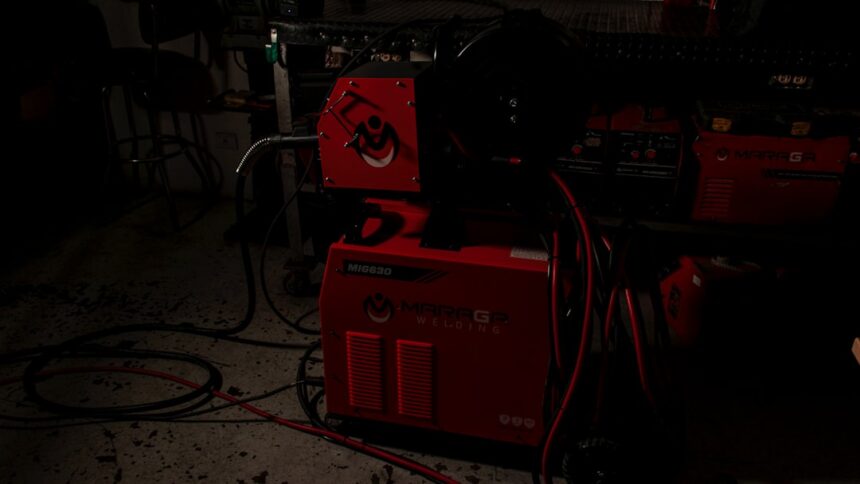
MIG welding is the workhorse of auto body repair. Every serious body shop and enthusiast garage has one, and the technology has evolved dramatically over the past decade — modern inverter-based MIG welders deliver professional-quality welds in packages small enough to sit on a workbench. This guide covers 6 MIG welders that consistently deliver strong results for auto body work across a range of budgets, from $299 hobbyist units for occasional repairs to $2,499 professional welders capable of aluminum and structural work.
Our top picks for 2026
Hobart Handler 210 MVP Auto-Set MIG Welder
The gold standard for serious auto body work. 210A capacity handles up to 3/8-inch steel. Multi-voltage plug (MVP) technology lets you switch between 115V and 230V power without adapters. Auto-Set feature automates parameters based on material and wire — great for beginners, still respected by pros. Handles steel, stainless, and (with spool gun add-on) aluminum. typically.
Check Price on Amazon →Forney Easy Weld 261 MIG Welder
The best budget option for serious hobbyists. 140A output handles up to 1/4-inch steel — plenty for auto body work. 120V power runs off any household outlet. Trade-offs: no built-in gas setup (uses flux-cored wire) which limits penetration on thin body panels. Great for practice, entry-level projects, and occasional repairs.
Check Price on Amazon →Miller Multimatic 220 AC/DC
Multi-process (MIG + stick + TIG) welder with AC/DC TIG for aluminum. If you need to weld aluminum body panels or want maximum versatility, this is the tool. Auto-set intelligence + Miller build quality. Overkill for casual users, essential for professional or serious enthusiast shops that see aluminum work.
Check Price on Amazon →Lincoln Electric Weld-Pak 140HD MIG
Reliable 120V MIG welder from Lincoln, one of the two industry-standard brands. 140A output. Gas + flux-cored capability. Great for someone stepping up from a Harbor Freight welder to a real, reliable machine.
Check Price on Amazon →YesWelder MIG-205DS Multi-Process Welder
Chinese-manufactured but well-reviewed multi-process welder with 205A output. Excellent value at $499-$599. Handles MIG, MIG-brazing (great for high-strength body panels), stick, and lift-TIG. Trade-offs: smaller dealer network vs. Miller/Hobart/Lincoln. Popular with home shops looking for pro capability at hobbyist prices.
Check Price on Amazon →HTP America Pro Pulse 220MTS
Pulse-MIG welder capable of high-quality aluminum welding without spool gun. 220A output. Popular with professional aluminum body shops. Pulse capability delivers cooler welds that reduce warping on thin panels.
Check Price on Amazon →How to pick the right MIG welder for auto body
Match amperage to your work
- Under 140A: Sheet metal, patch panels, light-gauge steel. Fine for basic body repair, insufficient for structural work.
- 140A-200A: All body panel work, most structural repair on cars. The sweet spot for auto body.
- 200A-250A: Truck frame work, heavy structural repair, thick material. Overkill for most auto body but useful if you also fabricate.
- Over 250A: Industrial fabrication. Rarely needed for auto body.
Voltage requirements
- 120V (household outlet): Convenient — plug into any outlet. Limited to lower amperage and thinner materials. Great for entry-level.
- 230V (dryer outlet): Higher amperage capability, better duty cycle, more capable overall. Need dedicated circuit — most home garages have one.
- Multi-voltage (MVP): Some units switch between voltages. Convenient if you’ll use in multiple locations.
Gas capability
- Gas-only: Requires shielding gas (usually 75/25 argon/CO2 for steel). Better welds, less spatter, cleaner appearance.
- Flux-cored only: Uses self-shielding wire — no gas needed. Better for outdoor/windy work but leaves slag and rougher welds.
- Both capable: Most versatile. Use gas indoors, flux-cored when circumstances demand.
Aluminum capability
- Not all MIG welders handle aluminum well. Aluminum requires a push-pull or spool gun to feed the soft wire.
- Modern Ford, Chrysler, and luxury vehicles use extensive aluminum — increasingly important capability.
- If you work on late-model vehicles, aluminum capability matters.
The MIG welding process — what actually happens
The basics
MIG (Metal Inert Gas) welding uses a continuously-fed wire electrode and shielding gas to create welds. The wire acts as both electrode (creating an arc) and filler material (adding metal to the weld). Shielding gas prevents atmospheric contamination that would weaken the weld.
The MIG welding sequence
- Clean the material. MIG welding requires clean, bare metal. Grind off paint, rust, and mill scale. Wipe with acetone.
- Set your parameters. Match voltage, wire speed, and gas flow to material thickness and wire diameter.
- Position for gravity. Flat welds are easiest. Vertical and overhead take practice.
- Trigger arc and move. Squeeze trigger to start arc. Move gun at consistent speed with correct angle.
- Watch the puddle. Consistent puddle shape indicates correct heat + speed.
- Overlap correctly. Successive weld beads should overlap 30-50% of previous bead width.
- Finish smoothly. Reduce heat at end of weld to prevent crater. Some welders have crater fill features.
Common MIG welding mistakes
- Not cleaning material: Paint, rust, oil, and mill scale contaminate welds
- Wrong wire diameter: Too thick for thin material burns through; too thin for thick material lacks penetration
- Wrong gas mixture: Pure CO2 vs. 75/25 argon/CO2 vs. tri-mix for stainless
- Inadequate ground clamp: Poor ground causes arc issues
- Moving too fast: Weld doesn’t penetrate; “cold” weld appearance
- Moving too slow: Burn-through on thin material; heavy weld bead on thick material
Auto body specific welding considerations
Sheet metal specifics
Auto body panels are typically 16-20 gauge steel (0.037-0.062 inch thick). This is thin material that requires careful heat management to avoid burn-through and warpage.
Recommended settings for common panels
- Floor pans (14-16 gauge): 100-140A, 0.030 wire, 75/25 gas
- Body panels (18-22 gauge): 60-90A, 0.023 wire, 75/25 gas
- Rocker panels (14-16 gauge): 100-140A, 0.030 wire, 75/25 gas
- Roof panels (20-22 gauge): 50-75A, 0.023 wire, 75/25 gas
- Frame rails (10-12 gauge): 140-200A, 0.035 wire, 75/25 or CO2
Techniques for auto body welding
- Stitch welding: Short bursts of weld with cooling periods between. Prevents warpage on thin material. Standard technique for body panels.
- Skip welding: Weld in one spot, skip 6 inches, weld another spot. Return and fill in gaps. Distributes heat.
- Backing panels: Use copper or aluminum backing behind the weld to prevent burn-through.
- Cool between welds: Let material fully cool between weld sequences to prevent warpage.
MIG brazing (increasingly important)
Modern high-strength steel (HSS) and advanced high-strength steel (AHSS) can’t be welded with traditional MIG techniques — the heat weakens the steel. MIG brazing uses copper-silicon wire at lower temperatures to join these materials without heat damage.
OEMs including BMW, Mercedes, and increasingly Ford, GM, and Toyota specify MIG brazing for repair of certain panels. If you work on late-model vehicles with these materials, MIG brazing capability is important.
Setup and consumables checklist
Beyond the welder itself
- Shielding gas cylinder: 75/25 argon/CO2 for steel. #40 tank is typical for occasional use; #80 for regular use.
- Regulator + flow meter: Sets gas flow to 15-25 CFH depending on conditions.
- Extra wire spools: ER70S-6 for steel, 0.023-0.035 diameters.
- Extra contact tips: Wear out with use. Buy in quantity.
- Extra nozzles: Get damaged from spatter. Multiple sizes.
- Anti-spatter spray: Prevents spatter from sticking to nozzle and workpiece.
- Ground clamp: Better than the one that comes with cheaper welders.
Safety equipment
- Auto-darkening welding helmet ($80-$350). Do not weld without one.
- Leather welding gloves ($20-$45).
- Leather jacket or welding apron ($40-$100).
- Steel-toe boots.
- Fire extinguisher within reach.
- Well-ventilated work area — never weld in enclosed space without ventilation.
FAQ
Which MIG welder is best for beginners?
Hobart Handler 140 or 210 MVP is the industry-standard entry point. Reliable, well-supported, easy to use. Under $700 gets you a real welder that won’t limit your growth.
Do I need aluminum-welding capability?
Depends on what you work on. 2010+ Ford F-150 and increasingly other trucks + luxury cars use extensive aluminum. If you work on late-model vehicles, yes. If you work on classic cars, no.
What gas do I need for MIG welding steel?
75% argon / 25% CO2 mixture is standard for auto body sheet metal. Pure CO2 gives deeper penetration but rougher weld appearance. 75/25 is the compromise for auto body work.
Can I weld outdoors with a MIG welder?
Only if using flux-cored wire (self-shielding). Gas-shielded MIG welds get contaminated by wind moving the shielding gas. Flux-cored costs more per weld but works outdoors.
How much does a MIG welding setup cost?
Entry-level: $300 for welder + $150 gas + $50 helmet + $50 gloves + $50 misc = $600 total. Serious hobbyist: $1,000-$2,000 total. Professional: $3,000-$5,000 total.
What’s the difference between MIG and TIG welding?
MIG uses continuously-fed wire and is faster and easier to learn. TIG uses a separate filler rod (or none) and produces higher-quality welds but is slower and harder to learn. For auto body, MIG is standard; TIG is for specialty work.
Do I need 220V power for MIG welding?
For most auto body work, yes. 110V welders are limited to thin material. Most home garages have 220V outlets (for dryers) that can be adapted.
What size wire should I use for auto body?
0.023 inch for thin body panels (18-22 gauge). 0.030 inch for structural work (14-16 gauge). Different diameters require different tip inserts.
Can I weld aluminum with a regular MIG welder?
With a spool gun attachment, yes. Aluminum wire is too soft to feed through a standard MIG welder cable. Spool guns place the wire spool directly on the gun, eliminating the feed problem.
Which welder brand is most reliable?
Miller and Lincoln are the two American professional standards, both extremely reliable. Hobart (owned by Miller) is the value-conscious version of Miller. All three have strong dealer/service networks.
Bottom line
Match your equipment investment to how you’ll actually use it. Overbuying wastes money; underbuying wastes time. All our top picks are proven, well-supported, and represent good value at their price tier.