
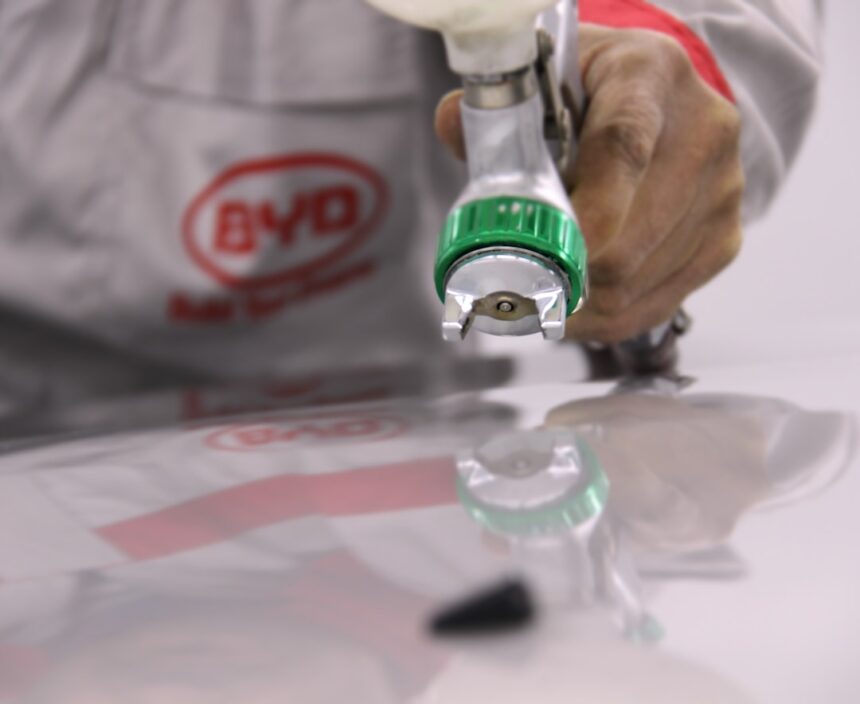
Painting your car yourself is one of the most ambitious DIY projects — and one of the most rewarding when done right. A DIY paint job costs $300-$800 in materials vs. $2,500-$8,000 for professional service. This guide covers the complete process from stripping through clear coat, plus the mistakes that ruin most DIY paint jobs.
What you actually need
Equipment
- Air compressor (20+ gallons, 8+ CFM at 90 PSI minimum)
- HVLP or LVLP spray gun ($60-$300)
- Water separator + regulator ($40-$150)
- Respirator (organic vapor cartridges — not dust mask)
- Full paint suit (Tyvek disposable)
- Nitrile gloves + safety glasses
- Paint booth or well-ventilated garage
- Overhead lighting (100+ lumens per sq ft, 5000K, 90+ CRI)
Materials
- Paint stripper or sanding equipment
- Sandpaper set (80-2000 grit)
- Rust converter if needed
- Epoxy or 2K urethane primer
- Body filler for imperfections
- Basecoat + hardener
- 2K clear coat + hardener
- Reducers/thinners
- Panel prep + wax and grease remover
- Tack cloths
The complete process — 7 days
Day 1: Stripping + assessment
- Remove trim, badges, moldings — anything that can be removed
- Wash and degrease entire vehicle
- Strip old paint using chemical stripper or mechanical sanding
- Assess for rust — treat with rust converter
- Assess for body damage — address before painting
Day 2: Body work
- Repair dents, scratches, and imperfections
- Apply body filler in thin coats
- Sand smooth (80 → 220 grit)
- Wipe clean with panel prep
Day 3: Primer
- Mask edges and adjacent panels
- Wipe with tack cloth
- Apply first coat of primer (thin, dust coat first)
- Wait 10-20 minutes recoat window
- Apply second coat
- Sand with 400 grit
- Apply third coat if imperfections remain
- Let cure 24 hours minimum
Day 4: Final surface prep
- Sand primed surface with 600 grit
- Wipe with panel prep
- Tack cloth thoroughly
- Move to painting environment (dust-controlled area)
Day 5: Base coat
- Mix base color with reducer + hardener per manufacturer ratio
- Apply thin dust coat first (light, doesn’t cover)
- Wait 10 minutes flash time
- Apply first full coat
- Wait 15-20 minutes between coats
- Apply 3-4 total coats until color is uniform
- Let cure 24 hours before clear coat
Day 6: Clear coat
- Sand base coat lightly with 800 grit
- Wipe with panel prep, tack cloth
- Apply first coat of 2K clear (thin, wet)
- Wait 15-20 minutes
- Apply 2-3 additional coats
- Let cure 24-48 hours
Day 7: Wet sand + polish
- Wet sand with 1500-2000 grit
- Continue to 3000 grit
- Polish with cutting compound + random orbital
- Follow with finishing polish
- Apply sealant or wax
- Reinstall trim and badges
The critical mistakes
- Skipping prep: Bad prep = bad paint job. Prep is 60-70% of the work.
- Wrong environment: Dust + wind + wrong temperature destroys finish.
- Wrong material sequence: Some primers incompatible with some base coats.
- Rushing between coats: Solvents don’t fully evaporate → orange peel.
- Wrong technique: Arcing gun, inconsistent speed → uneven coverage.
- Wrong pressure: Too high → excess overspray. Too low → poor atomization.
- Skipping clear coat wet sand: Final finish stays orange peely.
- Not enough patience: Fresh paint needs 30-90 days to fully cure.
Budget breakdown
- Basic single-color DIY ($300-$500): Sandpaper, primer, single-stage paint, spray gun rental. Adequate for older/utilitarian vehicles.
- Mid-tier base + clear DIY ($500-$800): Full material list, own spray gun, decent air compressor. Professional-quality result possible.
- High-tier DIY ($800-$1,500): Premium paint (Axalta, PPG), better spray gun, proper booth setup. Show-quality possible with experience.
- Compare to shop: Basic single-stage repaint: $2,500-$4,500. Base + clear coat: $4,500-$8,000. Show quality: $8,000-$25,000.
When to give up and use a shop
- Your first attempt looked terrible → practice on other panels first
- You can’t achieve controlled environment (dust-free area)
- Value of vehicle greatly exceeds paint job cost
- Perfect color match needed (metallic/tri-coat especially)
- Time-pressure — DIY takes 40-80 hours
Best products for this project
SPRAYIT SP-33000 LVLP Gravity Feed
Excellent beginner LVLP gun. Works with small compressors. Standard for DIY paint work.
Check Price on Amazon →SprayMax 2K Aerosol Clear Coat
Professional 2K clear from aerosol. Delivers pro-quality finish without spray gun.
Check Price on Amazon →Meguiar’s Ultimate Compound
Post-paint compounding for smooth finish.
Check Price on Amazon →Dupli-Color Perfect Match Automotive Paint
For touch-ups and small projects. Match your paint code exactly.
Check Price on Amazon →SPI Epoxy Primer
Professional-grade epoxy primer with excellent adhesion.
Check Price on Amazon →Bondo Body Filler
For smoothing surface imperfections before paint.
Check Price on Amazon →3M Half-Mask Organic Vapor Respirator
Essential safety for paint work. Organic vapor cartridges required.
Check Price on Amazon →DuPont Tyvek Disposable Coverall
Full-body coverage. Disposable after use.
Check Price on Amazon →FAQ
Can I paint my car in a garage?
Yes if adequately ventilated. Detached garage with fans + open doors preferred. Never in enclosed space without ventilation.
How much does DIY car paint cost?
$300-$1,500 depending on paint quality + supplies. Compare to $2,500-$8,000+ shop pricing.
How long does DIY car painting take?
7-14 days including prep + cure time. 40-80 hours actual labor.
Do I need a paint booth?
Not for adequate results. Dust and wind are enemies, but well-ventilated garage with proper filtration works.
Can I match factory color perfectly?
Solid colors yes with paint code match. Metallic and tri-coat: very difficult DIY. Use factory-matched aerosol or bring to a paint shop for spray-can mixing.
What clear coat should I use?
2K catalyzed clear coat only. Single-stage clear from rattle cans doesn’t provide adequate protection or gloss.
How long until I can wash my newly-painted car?
Days 1-2: don’t wash. Days 3-30: hand wash only. Days 1-90: no automated car washes.
Is DIY paint job worth the risk?
For daily drivers or projects: yes. For collector cars or expensive vehicles: probably professional shop. Practice on scrap panels first.