
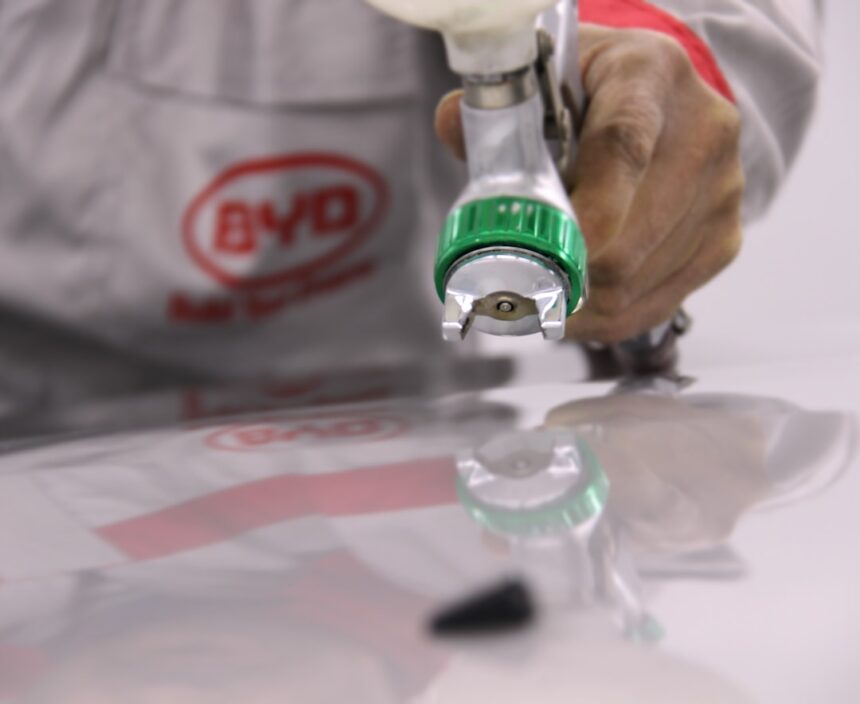
Rotary polishers cut faster and more aggressively than dual-action polishers — they’re the tool of choice for professionals doing paint correction on show vehicles and heavy defect removal. But rotaries can burn through paint or leave hologram swirls in seconds with poor technique. This guide covers rotary polishers for pros and advanced DIYers who’ve moved past DA polishers.
Best picks for 2026
Milwaukee 2648-20 M18 Rotary Polisher
M18 battery platform. Variable speed 800-3000 RPM. Perfect for mobile detailing. Uses Milwaukee’s popular battery system.
Check Price on Amazon →Rupes Bigfoot LHR15 Rotary Polisher
Pro-grade corded rotary. Silky-smooth operation, minimal vibration. The polisher every detailing pro learns advanced techniques on.
Check Price on Amazon →Makita 9227C Variable Speed Rotary Polisher
. Solid pro-grade rotary at a fraction of Rupes cost. Longtime workhorse in the detailing industry.
Check Price on Amazon →Buff Pro 700W Rotary Polisher
Entry-level rotary. Not as refined as Makita but adequate for learning rotary technique.
Check Price on Amazon →Chemical Guys Wool Cutting Pads (3-Pack)
Wool pads for aggressive rotary compounding. Complement rotary polisher for maximum cut speed.
Check Price on Amazon →Chemical Guys Hex Logic Foam Pads (Cut + Polish + Finish)
3-pack of foam pads for rotary use. Cut with orange, polish with white, finish with black.
Check Price on Amazon →DA vs. rotary comparison
- DA (dual-action): Random pattern. Beginner-safe. Slower correction.
- Rotary: Spins in one direction. Cuts faster. Requires expert technique.
- For beginners: Start with DA. Move to rotary only after 20+ hours of DA practice.
When rotary is better
- Heavy defect removal on show-quality paint
- Very aggressive cutting compound work
- Professional detailing volume
- Correction of holograms/swirls (rotary hologram, then DA finish)
Rotary technique essentials
- Start at 800 RPM to spread compound
- Increase to 1500-1800 RPM for cutting
- Never stop moving — burn through paint in seconds if you pause
- Angle the pad slightly (don’t hold flat) — reduces holograms
- Work in small 12×18 inch sections
- Follow rotary with DA finishing pass — removes any rotary marks
- Cool pad frequently — heat destroys clear coat
Common mistakes
- Not practicing on scrap panels first — permanent damage
- Working too long in one spot — burn through in seconds
- Wrong pad-to-compound match — inconsistent results
- Not finishing with DA — visible rotary swirl marks
Safety essentials
- Extension cord dedicated to polisher (voltage drop causes burns)
- Anti-static mat (holograms from static electricity)
- Well-lit work area (see defects clearly)
- Air-conditioned space (heat = burn risk)
Learning path
- Start with DA polisher (20+ hours practice)
- Watch professional tutorials specifically for rotary
- Practice on junkyard panels or non-visible panels
- Only move to your daily driver after 10+ hours of rotary practice
FAQ
Are rotary polishers safe for beginners?
No. Rotary polishers can burn through clear coat in seconds. Learn on DA polisher first.
What’s the difference between DA and rotary polishers?
DA oscillates randomly (safer). Rotary spins in one direction (faster but requires expert technique).
Do I need a rotary polisher for auto body work?
Only for pro-level paint correction. DA polishers handle 95% of DIY needs.
What speed for rotary polishing?
800-1000 RPM for spreading. 1500-1800 RPM for cutting. Never stop moving at speed.
How long does it take to learn rotary polishing?
20-40 hours of practice for competence. 100+ hours for pro-quality results consistently.
Can I use rotary on a Tesla?
With expert technique only. Tesla’s thin factory clear coat is unforgiving. DA polisher is safer choice.
Bottom line
Match your budget to your usage level. All picks are proven, in-stock on Amazon, and represent good value at their price tier.