
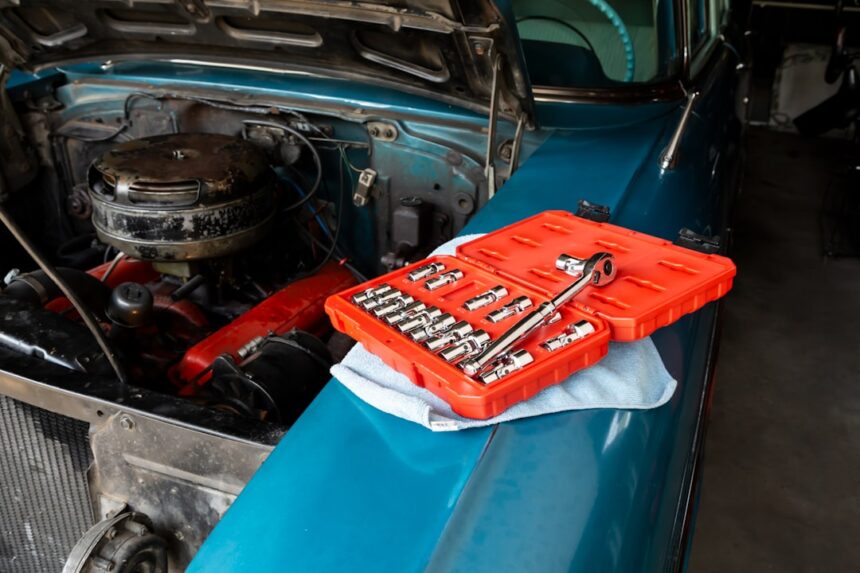
Auto body technicians utilize specific tools in their toolbox to complete tasks like removing dents and repainting vehicles, while students looking to enter this industry also benefit from having such equipment at their disposal.
Air Recirculating Blasting Cabinets provide an easy, fast, safe and fast method of blasting off paint, rust, contaminants and other surface contamination from vehicles quickly and safely. In addition, these units also help sand and shape surfaces easily.
Paint Spray Gun
Paint spray guns are an essential painting tool, using compressed air from a nozzle to apply liquid coating in an controlled pattern. Additionally, these guns can also be used for dispensing adhesives, sealants, or other fluids. There are different kinds of spray guns on the market today – gravity-feed guns with cups on top or conventional-feed guns with cups on bottom.
An effective paint spray gun can help you achieve professional-grade finishes on your work. To keep it functioning smoothly and evenly, it’s essential that your spray gun be thoroughly clean after each use – this will prevent it from clogging and keeping the paint flowing evenly across its spray pattern. To keep this from occurring, always wipe down nozzle and air cap after each use with gun cleaning solvent to avoid this possibility.
Soft triggers on paint spray guns are another essential feature, helping reduce fatigue for the operator while precisely controlling how much paint they apply – ideal when performing touch ups or trying to achieve certain finishes.
Auto body repair professionals require high-quality tools that will last and produce superior results, which is why DeVilbiss, Binks, Ransburg, BGK and Hosco are such trusted brands among automotive body shops and painters. Offering affordable prices alongside high-quality products and superior support – making these brands an excellent choice for professional auto body shops and painters.
Putty Knives
Putty knives are essential tools for repairing body damage such as holes or cracks. Additionally, you’ll require fillers such as body putty or metal filler – the knife’s job is to distribute this filler evenly over damaged areas – ensure a strong first application of putty so you can sand down after drying to create an even surface and ensure an attractive result.
When selecting a putty knife, look for one with a strong and durable handle, comfortable gripping surface and full tang blade extension into the handle – so as to decrease breakage risk. Professional use requires full tang knives.
A putty knife can be used to scrape away or apply multiple substances, including paint, grout, caulking, and plaster. Its small size makes it suitable for reaching into cracks or behind baseboards for easy application or scraping of old paint from surfaces while also testing for toxic substances like lead before trying removal attempts. When using this tool it is advisable to wear both protective gloves and a dust mask for your own safety.
Alternative tools available to you include drywall knives which resemble putty knives but with larger, wider blades more suitable to spreading and feathering drywall compound. Putty knives may even serve to replace taping knives where their intended tasks overlap – such as in tight spaces where neither tool will fit comfortably.
Dent Pullers
Dents happen, and when they occur on your car’s bodywork it can leave an unsightly mark. If the damage is minor and paint remains undamaged then you can use PDR (paintless dent repair) tools to use PDR (paintless dent repair) tools for pulling out small dents and dings; this technique works only with smaller-sized damage; experience and the appropriate tools are required in order to be successful at using this approach.
Use of bridge pulling kits is fairly straightforward, with most kits providing clear instructions. First, clean out the area to eliminate dirt and rust that may interfere with adhesive application, then prepare and apply the glue provided with your kit to the dented metal panels and wait the designated amount of time before attaching your bridge pulling tab (some kits use suction while others provide screw functions that allow you to easily remove or turn away from it in order to straighten out metal panels).
Dent removal tools come in two main varieties. One type is an induction dent removal machine, which uses heat to restore metal to its original form. These machines are typically utilized by professional body shops but can also be purchased as garage tools to make repairs faster and cheaper! Whether working on your own vehicle or professional body shop repairs, these tools allow you to complete repairs efficiently while saving yourself a trip costing more money at the shop!
Block Sander
Block sanders are tools used to level body filler and shape it before priming, using either hand blocks or air files to cross sand so as not to leave low spots that show through under paint. Start with 36 grit and work your way up to 80 before applying guide coat – when possible use longer blocks so you’re working a glass-like surface!
Body sanding blocks come in various sizes and shapes; you can purchase one with hook and loop or PSA adhesive for easy sandpaper attachment. Made of medium-density durable polyurethane foam with an acrylic composite backing plate that allows it to conform to vehicle body lines, these sanding blocks can even bend around tight spaces to hold flat and follow them.
Body solder is a mix of lead and tin that can be used to repair body damage. Once applied, it can be block sanded to create an almost glasslike finish before priming. A body file may also be employed to level highs and identify low spots before priming occurs; various punches are available for locating holes that need welding or soldering repairs in damaged areas.
Body Hammer & Dolly Set
Utilizing a body hammer and dollies instead of plastic body filler will save money while providing a superior finish on repaired areas. Though more time-consuming, its results make up for any extra work; you will use less body filler, spend less time sanding, and achieve a much nicer paint job in the end.
Our Deluxe Car-Body Hammer Set provides everything you need to repair physical damage on a fender or bumper, including three different hammers: standard bumping hammer, pick-and-finish hammer and reverse curve hammer all constructed from durable casting steel with nonslip fiberglass handles for a secure, comfortable grip with each swing. Furthermore, there are four dollies included within this set including: curved dolly, utility dolly double-end hand dolly shrink dolly for flattening sheet metal when hammers can’t reach them;
Hammer on Dolly (H&D) is an effective metal straightening technique to level off smaller imperfections in metalwork surfaces, yet with extra care taken not to stretch or stretche it too far. Should this occur, shrunk need to be done quickly by means of either a Chisel Hammer or Dolly Block for proper repair of any severe damage that cannot be fixed later. All hammers and dollies fit easily in our heavy-duty blow-molded storage case making this tool kit suitable for both professional and amateur metalworkers alike!
Grinder
A grinder is a powerful tool used to remove excess material from workpieces and shape surfaces to precise dimensions. Its versatility makes it a critical component of the auto body repair process; with multiple attachments it can cut metal edges, grind down welds and smooth rough surfaces.
Slide hammers may not be top of mind when considering auto body tools, but they’re an invaluable part of any shop’s arsenal. This device works by welding a small stud directly to panels, and using an effective sliding weight mechanism to generate force without actually striking them with force hammer weights – an efficient method for repairing large dents while returning panels back to their original shapes.
KECO glue pulling kits make aluminum body repair simple for technicians in shops using existing tools and equipment in your shop, eliminating grinding, drilling and welding while saving OEM paint while speeding up repair time.
Hirsch advises owning an angle grinder, especially one designed with right-angle die grinder blades designed specifically to use with sanding accessories and fit in tight spaces. Furthermore, he stresses the need to wear wide-vision face masks and safety goggles in order to prevent injuries while using this equipment.
Recommended Auto Body Tools
- Auto Body Hammer & Dolly Set (7-piece) — the foundation tool set for panel work ($40-80).
- 5-inch DA Random Orbital Sander — essential for smooth panel prep ($60-120).
- Paintless Dent Repair Kit — glue-pulling starter for small dents ($40-90).
- HVLP Automotive Spray Gun — for primer and paint work ($60-180).
- 110V MIG Welder — for patch panels and rust repair ($200-500).
- Nitrile Mechanic Gloves (100pk) — chemical-resistant, essential for prep and paint ($20-30).
Amazon affiliate links. The site earns a small commission on qualifying purchases.