
Updated April 2026. What frame repair actually involves, when it can be done vs. when a vehicle should be totaled, and why cutting corners here compromises crash safety. As an Amazon Associate we earn from qualifying purchases.
Frame damage is the highest-stakes body shop conversation you can have. Done right, a properly repaired frame is as safe as an undamaged one. Done wrong, or done cheap, and the vehicle can fail catastrophically in the next collision — often causing more damage or injury than the original impact would have. Below: the difference between frame types, how professional frame repair actually works, and how to know if the shop working on your car is qualified.
Types of Vehicle Frames
Recommended: post-collision protection tools
Handpicked Amazon products relevant to this guide. Prices vary, links go to current Amazon listings.
Body-on-frame construction
Older trucks, SUVs, and some vans have a separate steel ladder frame that the body bolts onto. Common on Ford F-150 (pre-2004), Chevy Silverado, Toyota Tacoma, Jeep Wrangler, and most full-size vans and RVs.
Repair approach: Body-on-frame is more forgiving. Bent sections can often be cut out and welded in with replacement frame sections. Structural welding is straightforward.
Unibody construction
Most modern passenger cars, most crossovers, and increasing numbers of SUVs use unibody construction — where the frame is integrated into the body panels. Common on nearly all sedans, most SUVs, and most modern trucks.
Repair approach: Unibody requires precision measurement and controlled straightening on a frame rack. Damage to structural sections often requires replacement panels rather than repair.
Space frame / spaceframe
High-performance vehicles (some BMW, Audi, Alfa Romeo) use spaceframe construction — a lightweight cage of tubes bonded to lightweight body panels. Rare and specialized.
Repair approach: Only manufacturer-certified shops with training and equipment can properly repair spaceframe damage.
The Frame Repair Process
Step 1: Assessment and measurement
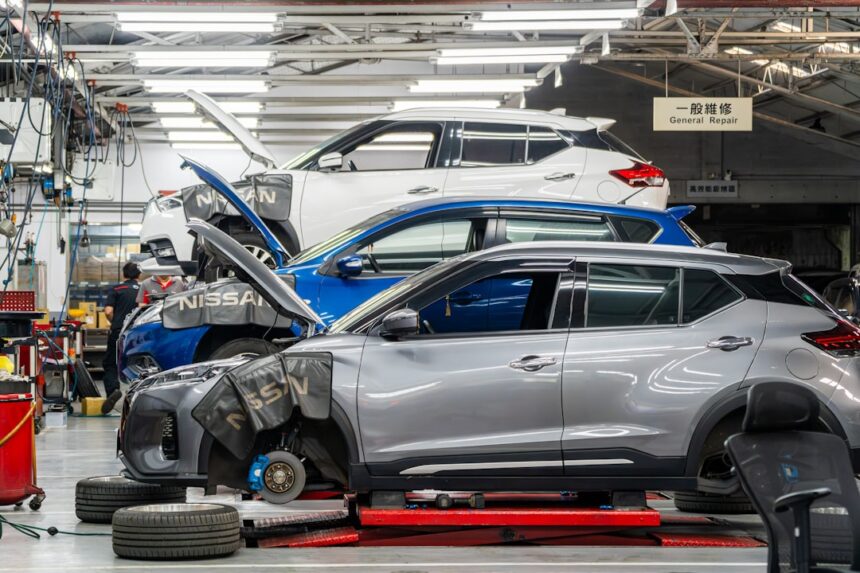
The shop puts the vehicle on a frame rack (a steel bench with precision measurement points). Laser or ultrasonic measurement systems check every dimension against factory specifications. Damage that’s more than 3-5mm out of spec typically needs correction.
Step 2: Damage analysis
Frame damage falls into categories that determine the repair path:
- Bent: Structural members deformed but not broken. Straightening possible.
- Twisted: Torsional damage from side impact. Straightening with careful pulling.
- Crushed / crumpled: Sections shortened by impact. Repair requires cutting out and welding in replacement sections.
- Cracked or torn: Steel has actually failed. Structural replacement required.
- Compromised crumple zones: Sacrificial crush structures deformed. Must be replaced with new sections designed to crumple in the next collision.
Step 3: Pulling and straightening
Frame rack anchor chains attach to strong points on the frame. Hydraulic rams apply calibrated force in specific directions to reverse the damage. This is the highest-skill part of the process — pulling too hard, in the wrong direction, or in the wrong sequence can cause worse damage.
Step 4: Structural welding and replacement
Where sections need to be replaced, replacement panels are welded in using manufacturer-specified procedures (typically MIG welding to factory-defined specs). Weld quality is critical for crash performance.
Step 5: Post-repair measurement
Frame is re-measured against factory specs. Every dimension should be within 3mm. Documentation should be provided to you as the customer.
Step 6: Alignment and calibration
Wheel alignment after frame repair is essential. ADAS calibration for vehicles with cameras and sensors is required if the damage affected mounting points.
When Frame Repair Beats Total Loss
Insurance companies calculate whether repair or total loss is cheaper. Frame repair typically runs $2,000-$10,000+ on a passenger car. If that plus the panel/paint work exceeds 70-80% of vehicle actual cash value, insurance will total the car instead.
Repair makes sense when:
- Vehicle is high-value (over $30,000 ACV).
- Frame damage is localized (bent front rail, straight-pull-out job).
- Vehicle has significant sentimental or collector value.
- Rare or discontinued vehicle where replacement isn’t feasible.
Total loss makes sense when:
- Vehicle is older or lower ACV.
- Damage affects multiple structural sections.
- Structural welding required in safety-critical areas (A/B/C pillars, roof rails).
- Frame twisting (torsional damage) that’s expensive to fully correct.
Buyback After Total Loss
If insurance totals your car and you’d be willing to drive it as-is:
- You accept the ACV payout (minus deductible).
- You buy back the vehicle at salvage value.
- You get a salvage title (which reduces resale value 40-60%).
- Some states require re-inspection before re-titling.
Buyback math often net-positive. Example: $12,000 ACV vehicle, $500 deductible, $2,500 salvage buyback. You net $12,000 – $500 – $2,500 = $9,000 while keeping the car.
Choosing a Frame Repair Shop
Not every body shop can do frame work. Look for:
- I-CAR Gold Class certification for the collision repair.
- Frame rack equipment visible in the shop (not sublet to another shop).
- Laser measurement system with digital documentation.
- Manufacturer certifications for your specific brand (essential for aluminum-body vehicles).
- Willingness to show you the pre and post measurements. Reputable shops document everything.
- Written warranty on structural work — typically lifetime.
Red Flags — Walk Away If You See These
- Shop can’t show you frame measurement equipment on-site.
- Shop won’t provide pre and post measurement documentation.
- Estimate seems dramatically low for the damage described.
- Shop pushes back when you ask about structural work certifications.
- “We’ll just bang it out” — frame work is precision measurement and controlled straightening, not banging.
- Shop doesn’t do wheel alignment as part of frame repair.
DIY Frame Repair: Almost Never Feasible
Frame repair is not DIY territory. Reasons:
- Frame racks cost $30,000-$100,000 and require significant floor space.
- Measurement systems cost $15,000-$50,000.
- Structural welding requires certified training.
- Errors compromise crash safety — with legal liability.
- Insurance won’t warrant DIY frame repair.
The rare exception: minor damage to body-on-frame trucks where the damaged section can be cut out and replaced (with a certified welder and manufacturer parts). Still requires post-repair measurement at a qualified shop.
Cost Reference
| Frame damage | Cost range |
|---|---|
| Minor: single rail bent, no structural replacement | $1,000-$3,000 |
| Moderate: multiple pulls, some crumple zone replacement | $2,500-$6,000 |
| Major: unibody structural section replacement | $4,000-$10,000 |
| Severe: twisted frame, multiple structural replacements | $8,000-$20,000+ |
| Aluminum-body vehicle (F-150, Audi): add | +30-60% |
| Wheel alignment after frame repair | +$100-$250 |
| ADAS calibration (if applicable) | +$200-$1,500 |
Insurance Considerations
- Frame damage is a collision claim (not comprehensive).
- Insurance requires certification of frame repair for warranty coverage.
- Diminished value claims are common after major frame repair — often $3,000-$8,000+ on higher-value vehicles.
- Insurance may require use of a certified shop for warranty purposes.
See our collision repair process guide for the full insurance-and-repair workflow.
Post-Repair Safety Verification
After frame repair, verify:
- Vehicle drives straight without pulling.
- Steering wheel is centered.
- All safety systems function (ABS, traction control, stability control, ADAS).
- Body panels align consistently at panel gaps.
- Doors, hood, and trunk open/close smoothly.
- No unusual noises during normal driving.
Any of these being off after repair should trigger an immediate return to the shop.
FAQ
Can a car with frame damage be safely driven again?
Yes, if properly repaired by a qualified shop with certified equipment. Improperly repaired frames compromise crash safety.
How much does frame repair cost?
Minor: $1,000-$3,000. Moderate: $2,500-$6,000. Major: $4,000-$10,000. Severe: $8,000-$20,000+. Aluminum vehicles add 30-60%.
Does frame damage affect vehicle value?
Yes, significantly. Even a properly repaired frame reduces resale value 20-40% because most buyers won’t consider frame-damaged vehicles. Diminished value claims from at-fault insurance can partially offset this.
How long does frame repair take?
Minor: 3-7 days. Moderate: 1-3 weeks. Major: 3-6 weeks. Parts availability often extends this.
Can I sell a car with a repaired frame?
Legally yes, and you must disclose it. Practically, the buyer pool is 30-50% smaller and price is 20-40% lower than an undamaged vehicle.
Should I total my car or repair the frame?
If repair cost exceeds 70-80% of vehicle ACV, insurance will typically total it. If between 40-70%, the decision depends on your attachment to the vehicle and the diminished value.
The Bottom Line
Frame damage is a serious repair that requires certified shops with proper equipment. Never accept “frame repair” from a general body shop without verifying they have a frame rack, measurement system, and certification. Frame work done right is safe; done wrong is dangerous. When in doubt, get a second opinion from an I-CAR Gold Class certified shop with manufacturer certifications.
For related repair topics, see our collision repair process guide, auto body welding guide, and how to choose a body shop.