
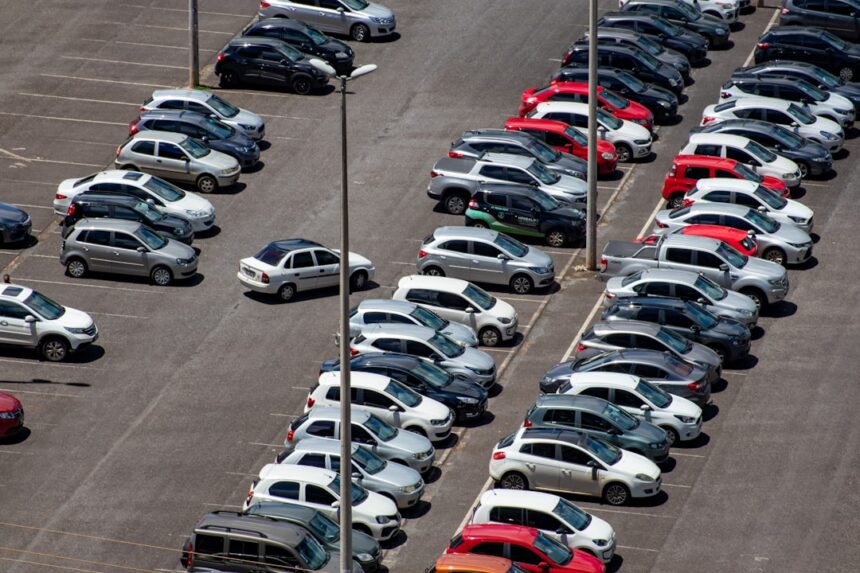
Parking lot damage is the least dramatic but most frequent form of auto body damage. Door dings, cart hits, hit-and-run bumps, and shopping-cart scratches account for roughly 40% of all body shop claims. Because most parking lot damage falls below typical deductibles ($500-$1,500), owners often pay out of pocket — which makes DIY skills and smart shop selection especially important. This guide covers what to do if you’re hit in a parking lot (or hit someone else’s car), the specific damage patterns, insurance strategy for hit-and-run situations, and how to DIY the most common repairs.
What to do if you’re hit in a parking lot
You caught the other driver at the scene
- Stay calm and exchange information. Even if the other driver is defensive or hostile, remain calm. Get their driver’s license, insurance card (photograph both sides), phone number, and vehicle plate/make/model.
- Photograph everything. Both vehicles from every angle, license plates, damage close-ups, the parking-lot layout, and any surveillance cameras visible on nearby buildings.
- Note witnesses. Anyone in nearby cars, store employees who came out, or shoppers who stopped. Get names and contact information.
- Call the police. Even for minor damage. Many stores’ insurance covers accidents on their property; a police report supports any subsequent claim. Some states require police reports for property damage above certain thresholds.
- File a claim. With your carrier if you have collision coverage, or with the other driver’s carrier if you can identify them. Property damage claims for parking lot damage are typically resolved in 2-6 weeks.
You found damage but the other driver is gone (hit-and-run)
- Look for surveillance cameras. Store parking lots, gas stations, banks, and many businesses have cameras that capture parking areas. Note nearby cameras and ask store management to preserve footage — most systems overwrite in 7-30 days.
- Check the vehicle for evidence. Paint transfer from the other vehicle is often visible on your damage — this indicates the other vehicle’s color. Photograph any transferred paint before it wears off.
- Ask nearby business owners. Employees who work parking-lot-facing shifts often see incidents. Ask if anyone noticed the other vehicle.
- Check for a note. Some drivers actually do leave notes. Check under wipers, on the windshield, and inside the vehicle if a door was left unlocked.
- File a police report. Essential for any hit-and-run claim. Get the report number. This documents the incident even if the other driver is never identified.
- File an uninsured motorist claim. Hit-and-run damage is covered under uninsured motorist coverage (UM) in most states. This may require paying your deductible but covers the repair.
- Consider not filing. If damage is $500-$1,500 and your deductible is $500 or higher, filing may not make sense. Many owners pay for minor hit-and-run damage out of pocket to avoid rate impact.
What to do if you hit someone else’s parked car
The right thing to do
- Don’t drive away. Hit-and-run is a crime in every state and often involves both criminal charges and significant civil liability if the other driver identifies you (via witnesses, surveillance, or your vehicle’s paint transfer).
- Look for the owner. In a parking lot, the owner may be in a nearby store. Check inside if practical. Some stores will page owners.
- Leave a note if the owner isn’t found. Include your name, phone number, insurance carrier, and policy number. Leave it securely under the windshield wiper. Some states legally require this.
- File a police report. Documenting the incident yourself with police protects you from later “he hit and ran” allegations and shows good faith.
- Report to your insurance. Filing quickly protects you if the other owner later files.
What happens legally if you drive away
Hit-and-run consequences vary by state but typically include:
- Misdemeanor charges (or felony if injury occurred elsewhere in the incident)
- Fines from $500 to $5,000+
- License suspension (30-90 days typical)
- Insurance rate increases (25-50% for 3-5 years)
- Points on driving record
- Potential civil liability for full damages (which insurance may not cover)
Common parking lot damage patterns
Door dings from adjacent cars
The most common parking lot damage. Someone opens their door into yours, leaving a small dent (usually 1-3 inches diameter) with paint transfer.
- Repair cost at shop: $150-$400 depending on size and paint match complexity
- PDR (paintless dent repair): $75-$200 mobile PDR appointment
- DIY: $30-$60 in materials for adhesive PDR tools + touch-up paint
Bumper scuffs from other bumpers
Someone backs into your bumper or tries to squeeze in beside you. Small crack, scuff, or paint transfer.
- Repair cost at shop: $425-$850 for cosmetic bumper repair
- Bumper replacement (if cracked badly): $950-$2,150
- DIY: $30-$50 for touch-up on scuff; $60-$100 with plastic welder for cracks
Shopping cart damage
Runaway carts hit vehicles constantly. Damage varies from paint scuff to bumper crack to panel dent.
- Store liability: Some stores accept liability for cart damage; most disclaim it. Check store policy.
- Repair cost: Same as door ding or bumper scuff depending on damage type
Wheel curb damage
Curb rash on alloy wheels from tight parking spaces or angled parking.
- Wheel repair at shop: $150-$350 per wheel for cosmetic repair
- Wheel replacement (if cracked): $450-$1,500 per wheel
- DIY wheel restoration: $30-$60 in materials for cosmetic curb rash repair
Fender damage from tight spaces
Squeezing into a spot and scraping the fender against an adjacent vehicle or pillar.
- Shop repair: $650-$1,850 depending on damage extent
- DIY: Touch-up ($30-$50) for surface damage; not DIY-appropriate for deeper damage
Mirror damage
Sideswipe damage to side mirrors, cracked glass, or ripped-off mirror housing.
- Mirror glass only: $50-$150 shop, $20-$45 DIY replacement
- Full mirror assembly: $200-$650 shop, $75-$275 DIY replacement (heated/power mirrors)
DIY repair walkthrough for common parking lot damage
Fixing a door ding with PDR
Small door dings without paint damage are the perfect DIY project. A basic PDR kit costs $30-$80 and you can achieve professional results with practice.
- Assess the dent. Circular dents 1-3 inches diameter without creases or paint damage are ideal for DIY. Avoid creased dents or dents where paint is cracked.
- Clean the area. Wash with soap and water, dry thoroughly.
- Choose your tool. Two approaches: glue-pull PDR (glue tabs stuck to the dent, then pulled outward) or push-out PDR (rod inserted behind the panel through door interior).
- Glue-pull approach: Apply glue to a plastic tab, press onto dent center, wait 60-90 seconds to set. Use slide hammer to pull outward. Repeat with progressively smaller tabs until dent is level. Peel off tabs, remove residual glue with alcohol.
- Push-out approach: Remove the interior door panel (screws and clips), access the back of the dent, use PDR rod to push outward while checking front. This is trickier but works better for larger dents.
- Finish with polish. Any minor swirls from the process buff out with polish.
Fixing a bumper scuff
Scuffs on plastic bumpers with minor paint transfer are common. Real DIY project.
- Wash the area. Soap and water, then wipe with isopropyl alcohol.
- Sand progressively. Start with 400-grit wet sandpaper to level the scuff. Progress to 800, 1500, and 2000 grit for smooth finish. Sand about 2 inches beyond the damaged area to blend.
- Apply adhesion promoter. Skip this step and paint will peel within months. Spray or wipe on adhesion promoter and let dry 5-10 minutes.
- Apply primer. If you’ve broken through to bare plastic, apply plastic primer. Let dry 20 minutes.
- Apply color coat. Match your paint code exactly. Spray or brush in 3-4 very thin coats, letting each dry 10 minutes.
- Apply clear coat. 2-3 thin coats, let dry between each.
- Wait 48-72 hours to cure. Do not touch or wash during this time.
- Polish. Buff with polishing compound to blend with surrounding paint.
Fixing a plastic bumper crack
Small cracks (under 4 inches) can be plastic-welded from behind, then finished on the front side.
- Remove the bumper cover. Consult your vehicle’s service manual. Usually involves removing wheel-well fasteners and lifting off.
- Clean crack area. Sand around the crack on the back side (unseen side) with 80-grit for good weld adhesion.
- Plastic weld the back side. Use a plastic welder with rod matching the bumper material (TPO for most modern vehicles). Melt the rod into the crack from behind, creating a bead of new plastic. This restores structural integrity.
- Optional: reinforce with mesh. For larger cracks, embed metal mesh in the weld for additional strength.
- Sand the front side. Feather the sanding out about 2 inches beyond the crack.
- Fill any front-side damage. Use flexible body filler for small gouges.
- Paint the front side. Adhesion promoter, primer if needed, color, clear coat as above.
Fixing curb rash on alloy wheels
Cosmetic-only wheel damage from curbs. Not for cracked wheels — those need professional repair or replacement.
- Clean the wheel. Remove the wheel from the vehicle for easier work.
- Sand the damage. 220-grit to level, then 400, 800, 1500 for smooth finish.
- Apply wheel-specific putty for deeper damage. Available at auto parts stores.
- Sand smooth once cured. 800 → 1500 grit.
- Apply primer and paint. Match wheel color exactly. Wheel paint kits are available in silver, gunmetal, black, and gloss silver.
- Apply clear coat. Let cure 48 hours before mounting.
Insurance strategy for parking lot damage
When to file a claim
Filing a parking lot damage claim isn’t always the right move. Consider these factors:
- Your deductible: If damage is under your deductible, filing accomplishes nothing except potentially raising rates.
- Fault status: If you’re not at fault, filing has minimal rate impact in most states.
- State laws: Some states prohibit rate increases for non-fault claims; some allow them.
- Claim frequency: Multiple small claims within a few years often trigger rate increases even for non-fault claims.
- Repair cost vs. deductible: If damage is $600 and your deductible is $500, your net benefit is $100 — probably not worth the potential rate impact.
When filing makes sense
- Hit-and-run where you’re not at fault (typically covered under UM without your rate increasing)
- Damage significantly exceeds your deductible
- You have a “diminishing deductible” or “vanishing deductible” that reduces with each claim-free year
- Damage affects safety systems (airbags, ADAS, structural)
When to pay out of pocket
- Damage under $1,500 and your deductible is $500+
- You’ve had 2+ claims in the past 3 years
- Damage is entirely cosmetic
- You can DIY the repair
Best DIY products for this scenario
Anyyion 89-Piece PDR Kit
Complete PDR kit with glue-pull tabs, slide hammer, and various pull tools. Handles most parking-lot door dings. Practice on scrap panels first — technique improves quickly.
Check Price on Amazon →Meguiar’s ScratchX 2.0
For clear-coat scratches (fingernail-catches-on-it scratches usually respond). Apply by hand, buff out. Works on 60-70% of parking-lot scratches.
Check Price on Amazon →Astro Pneumatic 7600 Plastic Welder Kit
For repairing cracked bumper covers instead of replacing. TPO plastic welds easily. saves hundreds vs. bumper replacement.
Check Price on Amazon →Dupli-Color Perfect Match Automotive Paint
Match your paint code exactly. Essential for touch-ups, chip repair, and DIY scratch fixing. Includes brush applicator.
Check Price on Amazon →Chemical Guys Wheel Restoration Kit
For curb rash repair. Includes wheel putty, sandpaper, and matching wheel paint in multiple colors.
Check Price on Amazon →Ding King Ultimate PDR Kit
For practicing PDR at home. Includes training panels and detailed instructions. Great for developing skills before working on your actual vehicle.
Check Price on Amazon →Trim Fast Door Edge Guards
Clear or color-matched edge guards that prevent door-edge damage in parking lots. Simple prevention beats expensive repair.
Check Price on Amazon →Vantrue N4 3-Channel Dashcam
Front + interior + rear cameras. Captures parking lot hit-and-run evidence including license plates of departing drivers.
Check Price on Amazon →FAQ
What should I do if my car is hit in a parking lot and the driver left?
File a police report, check for surveillance cameras, look for witnesses, check for paint transfer indicating other vehicle color, and file an uninsured motorist claim with your carrier. Preserve any evidence quickly.
How much does parking lot damage typically cost to repair?
Range from $150 (small door ding) to $2,500+ (fender + bumper damage). Most parking-lot damage falls in the $300-$1,500 range.
Should I file an insurance claim for a small parking lot dent?
Only if damage exceeds your deductible plus $500-$1,000 buffer to account for potential rate increases. Many owners DIY or pay out of pocket for damage under $1,000.
Does insurance cover hit-and-run damage?
Yes, under Uninsured Motorist Property Damage (UMPD) or Collision coverage. You pay your deductible, insurance covers the rest. Some states include UMPD automatically; others make it optional.
Will my rates go up if I file a hit-and-run claim?
In most states, no — non-fault claims don’t affect rates. However, multiple claims within 3 years may trigger rate increases even for non-fault claims. Check your state law and your specific carrier’s policy.
How do I fix a door ding myself?
For small dings without paint damage, use a PDR (paintless dent repair) kit with glue-pull tabs. Apply glue to a tab, press onto dent, pull outward with slide hammer. Practice on scrap first.
How much does it cost to fix a bumper scuff?
Shop: $425-$850. DIY: $30-$50 in materials. Requires sanding, adhesion promoter, primer, color-matched paint, and clear coat.
What’s the difference between comprehensive and collision coverage for parking lot damage?
Comprehensive covers damage from non-collision events (theft, vandalism, hit-and-run in some states). Collision covers damage from a collision, even with a stationary object or parked car. Hit-and-run typically falls under both depending on state.
Can I sue the person who hit my parked car if their insurance won’t pay?
Yes. Small claims court is often the right venue for parking lot damage claims. Verify their insurance status first — if uninsured, collection may be difficult even with a judgment.
What if the store has a ‘not responsible for damage’ sign?
These signs are often unenforceable, especially if store negligence contributed (poor lighting, uneven pavement, unsupervised cart return, etc.). Consult with an attorney for damage exceeding $2,000.
Bottom line
Get comparison quotes via our free quote form, or browse verified body shops in our national directory.