
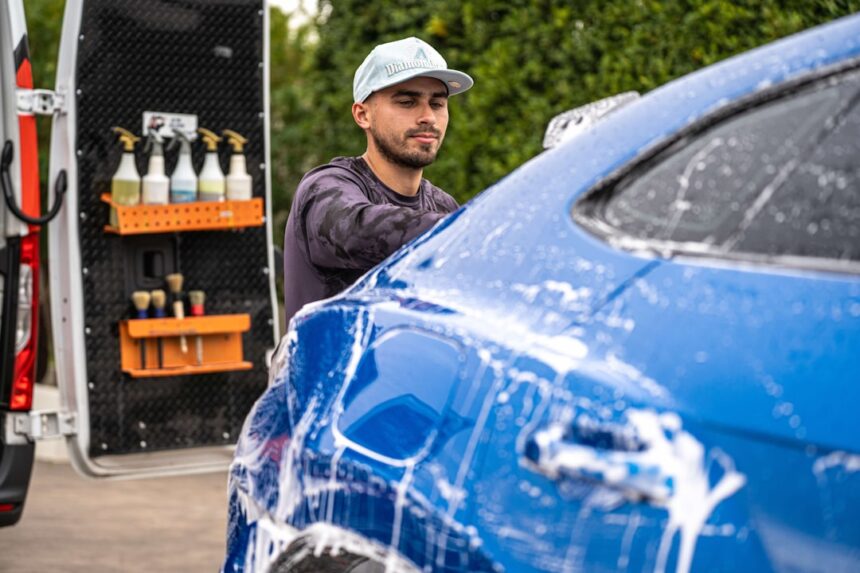
A professional detail costs $200-500 and takes a shop 3-4 hours. You can produce the same result at home in 4-6 hours for $80-150 in supplies — and it lasts longer because you controlled every step.
Choose Your Detail Level First
Not every detail needs to be a 6-hour job. Pick the level that matches your goal:
Level 1 — Maintenance Wash (75-90 minutes)
Two-bucket wash + drying + quick spray wax. Weekly cadence. Cost: $8-15 per detail.
Level 2 — Enhanced Detail (3-4 hours)
Level 1 + iron decon, clay bar, dressing all trim, interior wipe-down. Quarterly cadence. Cost: $25-40 per detail.
Level 3 — Full Correction + Coating (6-10 hours, spread over 2 days)
Level 2 + paint correction with DA polisher + ceramic coating application + interior deep clean. Yearly cadence. Cost: $80-150 including consumables.
Level 4 — Show-Quality (12-16 hours, spread over 3 days)
Level 3 + multi-stage paint correction + full engine bay + trim restoration + wheels off/apart. Every 2-3 years. Cost: $150-250.
Get 3 free quotes from local body shops
We match you with verified shops. Response within 24 hours.
Get my free quotes →Exterior — The 90% That Everyone Sees
Step 1: Pre-Rinse (5 min)
Hose the entire car top-down with plain water. This removes loose debris that would scratch during the wash phase. Focus extra attention on wheel wells, lower rocker panels, and behind the license plate — dirt accumulates most in these spots.
Step 2: Foam Cannon Pre-Wash (10-15 min)
Using a foam cannon attached to a pressure washer, apply a thick layer of pH-neutral car soap. Let it dwell 5-8 minutes — this dissolves 60-80% of grime before you touch the paint. Rinse thoroughly with pressure washer or hose.
No pressure washer? Use a pump-up foam sprayer with Chemical Guys Mr. Pink mixed strong (1 oz per 16 oz water).
Step 3: Two-Bucket Contact Wash (20-30 min)
Two 5-gallon buckets with grit guards at the bottom. One bucket has soap solution, one has rinse water. Wash mitt goes into rinse first, then into soap, then onto car. This prevents recirculating grit.
- Wash top to bottom: roof → hood → trunk → glass → upper doors → lower doors → rocker panels last
- Rinse the mitt in the rinse bucket between every panel
- Use a dedicated wheel/tire mitt — never mix with the paint mitt
- Work in shade or overcast conditions only
- If soap dries on paint before rinse, restart that panel
Recommended: microfiber wash mitts ($15-25 for 2-pack).
Step 4: Iron & Fallout Decontamination (10-15 min)
Spray iron fallout remover on all painted surfaces and let dwell 3-5 minutes. Watch the color change to purple/red as it dissolves brake dust and rail dust bonded to your clear coat. Rinse thoroughly.
Iron decon is the step that separates a good detail from a great one. Skipping it means every future wax or coating traps contaminants underneath.
Step 5: Clay Bar or Clay Mitt (15-25 min)
Keep the paint wet with quick detailer spray. Glide a clay bar across the wet surface in straight lines. You’ll feel resistance — that’s contamination transferring to the clay. Fold the clay to expose a clean surface every 30-60 seconds.
Never use a dropped clay bar — throw it away. Grit embedded from the ground will scratch every subsequent panel.
Prefer speed? Use a clay mitt instead — 3-4x faster and reusable across 10-15 details.
Step 6: Dry with Plush Microfiber (15-20 min)
Never air dry — mineral spots ruin your work. Use large plush microfiber drying towels. Blot, don’t drag. For crevices (mirror bases, badge edges), use compressed air or a blower.
Step 7: Paint Correction (Level 3+ only, 2-3 hours)
This is where you remove swirl marks and light scratches. Set up a DA polisher with a light-cut foam pad and cutting compound. Work 2×2 ft sections at speed 4-5, 4-6 passes each, moderate pressure.
Follow with a polishing pad + polish at speed 3-4 to remove haze. Wipe with clean microfiber, inspect under LED light, repeat if swirls persist.
Step 8: Wax, Sealant, or Ceramic Coating (30 min – 2 hours)
Choose based on how long you want protection:
- Wax (2-4 months): Meguiar’s Ultimate Liquid Wax — easy application, safe forgiving finish
- Sealant (6-12 months): Turtle Wax Ceramic Spray — spray-on convenience
- Ceramic Coating (2-3 years): CarPro CQuartz UK 3.0 — best DIY durability
Apply in 2×2 ft panels, wait per instructions (usually 60-90 seconds), remove with clean microfiber, work section by section.
Wheels & Tires (30-45 min)
Step 1: Cool Wheels Only
Hot wheels cause cleaner to flash-dry and etch the finish. Wait 30 minutes after driving.
Step 2: Spray Wheel Cleaner + Iron Decon
Use dedicated wheel cleaner (safer for coatings) or the iron decon spray you used on paint. Let dwell 2-3 minutes. Watch it turn purple as brake dust dissolves.
Step 3: Agitate + Rinse
Use a wheel brush for spokes, a smaller detail brush for lug nuts and inner barrel. Rinse thoroughly.
Step 4: Tire Dressing
Apply Chemical Guys VRP or Meguiar’s Endurance Gel to an applicator, then to tire (not directly to tire — controls sling). Wipe excess after 5 min.
Interior — Order Matters
Step 1: Empty + Trash (5-10 min)
Remove floor mats, everything from door pockets, cup holders, center console. Shake mats outside.
Step 2: Vacuum (20-30 min)
Use a cordless car vacuum or shop vac with narrow nozzle attachment. Under seats, between cushions, headliner (yes, headliners get dusty), trunk, spare tire well. Move seats forward and back to reach missed spots.
Step 3: Detail Brushes for Vents & Crevices (10-15 min)
Detail brush kits reach into AC vents, radio buttons, seat rails, seat belt tracks. Follow immediately with vacuum to catch dislodged dust.
Step 4: Clean Hard Surfaces Top-Down (20-30 min)
Spray interior all-purpose cleaner onto microfiber (not directly on surfaces — prevents overspray on electronics). Wipe dashboard, doors, console, steering wheel. Work top to bottom so drips don’t hit already-cleaned areas.
Step 5: Leather / Fabric Deep Clean (30 min)
Leather: Lexol Leather Cleaner on a soft brush, work in circles, wipe clean. Apply conditioner after cleaning — critical for preventing cracks.
Fabric: Fabric cleaner works with agitation. For deep stains, use a Bissell Little Green extractor. For spot stains, Folex is nearly magic.
Step 6: Glass (10 min)
Invisible Glass is ammonia-free and safe for tint. Use two towels — cleaner then dry. Roll windows down slightly to clean the top edge.
Step 7: Protect Plastic/Vinyl (10 min)
303 Aerospace Protectant applied thin to dashboard and door panels. UV protection prevents fading. Never use silicone-based products near steering wheel or pedals (dangerous slippery finish).
Trim Restoration (15-20 min)
Faded black trim ages a car dramatically. Solution Finish penetrates and lasts 6-12 months. Apply to clean, dry trim with foam applicator. Wipe excess after 10 min.
Engine Bay (Optional, 20-30 min)
Cover exposed electronics with plastic bags. Spray degreaser, agitate with brush, rinse gently with low-pressure water. Never pressure-wash an engine bay. Apply VRP dressing to plastic components after drying.
Time Investment Summary
| Level | Time | Result |
|---|---|---|
| Maintenance | 75-90 min | Clean, protected weekly |
| Enhanced | 3-4 hours | Show-ready for casual events |
| Full Correction | 6-10 hours | Swirl-free, ceramic-protected |
| Show Quality | 12-16 hours | Concours-grade finish |
Complete Detailing Kit Investment
- Foam cannon + 2 buckets + grit guards: $80-120
- Wash mitts + drying towels: $40-70
- Iron decon + clay bar + quick detailer: $50-80
- Wax or coating: $18-180 (choose based on level)
- Interior cleaners + protectants: $60-90
- Microfiber towels (bulk): $25-40
- Detail brushes: $15-25
- Wheel cleaner + tire dressing: $30-50
- Full kit: $320-655 — pays for itself in 2-4 avoided pro details
Common Mistakes That Ruin a Detail
- Washing in direct sun: soap dries before rinse, causes streaks and water spots
- Using dish soap: strips wax and ceramic coating instantly
- Single bucket wash: recirculates grit, causes swirls
- Skipping clay bar: traps contamination under wax
- Applying wax over dirty paint: locks in defects
- Air drying: water spots ruin the shine
- Working outside on windy days: dust contaminates every step
- Using paper towels on glass: causes lint and micro-scratches
Frequently Asked Questions
How often should I detail my car?
Maintenance wash weekly (15-30 min). Enhanced detail quarterly. Full correction + coating annually. Show detail every 2-3 years or before selling.
Can I detail a car in the driveway without a hose?
Yes — use rinseless wash products like Optimum No Rinse. Two buckets, two microfibers, ~2 gallons of water total.
How much does a professional detail cost vs DIY?
Pro: $150-500 per detail depending on level. DIY materials: $80-150 first time, $30-50 per subsequent detail (consumables only).
What’s the single most important step?
The wash phase. If you scratch the paint during washing, no wax or coating will hide it. Two-bucket method + microfiber mitts + working in shade prevents 90% of paint damage.