
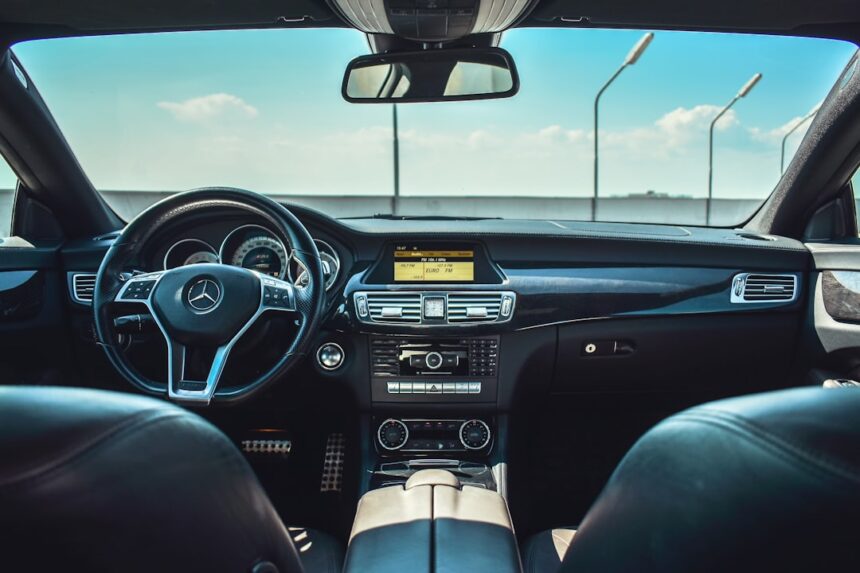
A professional interior detail costs $150-400. You can do a complete interior deep clean at home in 2-4 hours for $50-100 in supplies.
Complete Interior Cleaning Process
Preparation (5-10 minutes)
- Empty the vehicle completely: floor mats, personal items, trash
- Shake floor mats outside
- Check for loose items under seats, in seat pockets
- Park in shade with all doors open
Vacuum Phase (20-40 minutes)
Use a cordless car vacuum or shop vac with attachments:
- Seats — top, sides, between cushions, under
- Carpet and floor mats (both sides)
- Trunk — including spare tire well
- Under seats — move seats forward and back to reach everything
- Headliner — collects dust over time
- Seat rails and belt tracks — need narrow nozzle
- Console cup holders and center storage
Detail Brushes for Crevices (10-15 minutes)
Interior detail brush kits ($15-25) reach spots vacuum can’t:
- AC vents (use compressed air first)
- Radio buttons and knobs
- Steering wheel controls
- Seat belt tracks
- Speaker grilles
- Sunroof track (when open)
Follow immediately with vacuum to catch dislodged debris.
Hard Surface Cleaning (20-30 minutes)
Use interior all-purpose cleaner on microfiber (NEVER spray directly on surfaces near electronics):
- Dashboard top (start here — dust falls to lower surfaces)
- Steering wheel
- Center console and controls
- Door panels
- Door pockets and storage bins
- Sun visors
- Rear view mirror
Glass Cleaning (10-15 minutes)
Use automotive glass cleaner — ammonia-free protects window tint:
- Roll windows down slightly to clean top edge
- Use two microfibers — one for cleaner, one dry
- Wipe in one direction on inside, opposite on outside — reveals streaks
- Rearview mirror
- Interior side of windshield (extended-handle tool helps)
Leather / Fabric Deep Clean (30-45 minutes)
Depending on your seat material:
Leather Seats
Lexol leather cleaner, then leather conditioner. See our leather cleaning guide.
Fabric Seats
Chemical Guys Fabric Clean foam. Agitate with brush. For deep stains, use a Bissell Little Green extractor. For specific stains, Folex removes almost everything.
Vinyl / Synthetic Seats
Use interior all-purpose cleaner. These are the easiest to clean but need protection to prevent cracking.
Carpet and Floor Mats (15-30 minutes)
Vacuum first, then:
- Rubber mats: hose off outside, dry thoroughly
- Carpet mats: spray fabric cleaner, brush, extract with Bissell if available
- Original carpet: spot-clean stains, then apply carpet protector
UV Protection (10-15 minutes)
303 Aerospace Protectant ($18-28) prevents dashboard fading and cracking:
- Apply thin to dashboard and door panels
- Never on steering wheel or pedals (safety risk)
- Let sit 5-10 minutes
- Wipe excess with clean microfiber
Odor Treatment (Optional, 10-30 minutes)
- Ozone treatment (professional): $50-150, removes deep odors
- Odor absorber gel packs: $10-20, prevents new odors
- Baking soda in bowls left overnight: free, mild odor absorption
Complete Interior Kit Investment
- All-purpose interior cleaner: $15-22
- Leather or fabric-specific cleaner: $20-35
- Microfiber towels (36-pack): $25-40
- Detail brush set: $15-25
- Cordless vacuum: $40-90
- Glass cleaner: $10-16
- UV protectant: $18-28
- Total: $145-256 first time, $50-100 for subsequent deep cleans
Cleaning Frequency
- Basic maintenance: Weekly (vacuum floor mats, wipe dashboard, take out trash)
- Deep clean: Every 3-4 months
- Leather conditioning: Every 6 months
- UV protectant: Every 6 months
- Full detail: Annually (or before selling)
Common Mistakes
- Spraying cleaner directly on surfaces (damages electronics)
- Using household cleaners (too harsh)
- Not testing on inconspicuous area first
- Over-wetting fabric (causes mildew smell)
- Rushing between steps (dirt spreads)
Frequently Asked Questions
How long does an interior deep clean take?
2-4 hours for a thorough DIY job. Professional deep clean at a shop takes 1.5-3 hours but they have specialized equipment.
Can I use household cleaners in my car?
Not recommended. Household cleaners are formulated for different surfaces and often contain ingredients (bleach, ammonia) that damage automotive materials.
How do I remove smoke smell from a car?
Deep clean fabric surfaces + ozone treatment + odor absorber gel packs. Severe smoke may require professional detailing.
Should I use a steam cleaner on car seats?
For fabric: yes, careful use. For leather: generally no — too much heat can damage the polyurethane coating.
Related Guides
Related guides you may find useful
Explore more content from our body-work and DIY-repair library.